SHOEI J.O Review: ~25,000 km & 2.5 Years Later
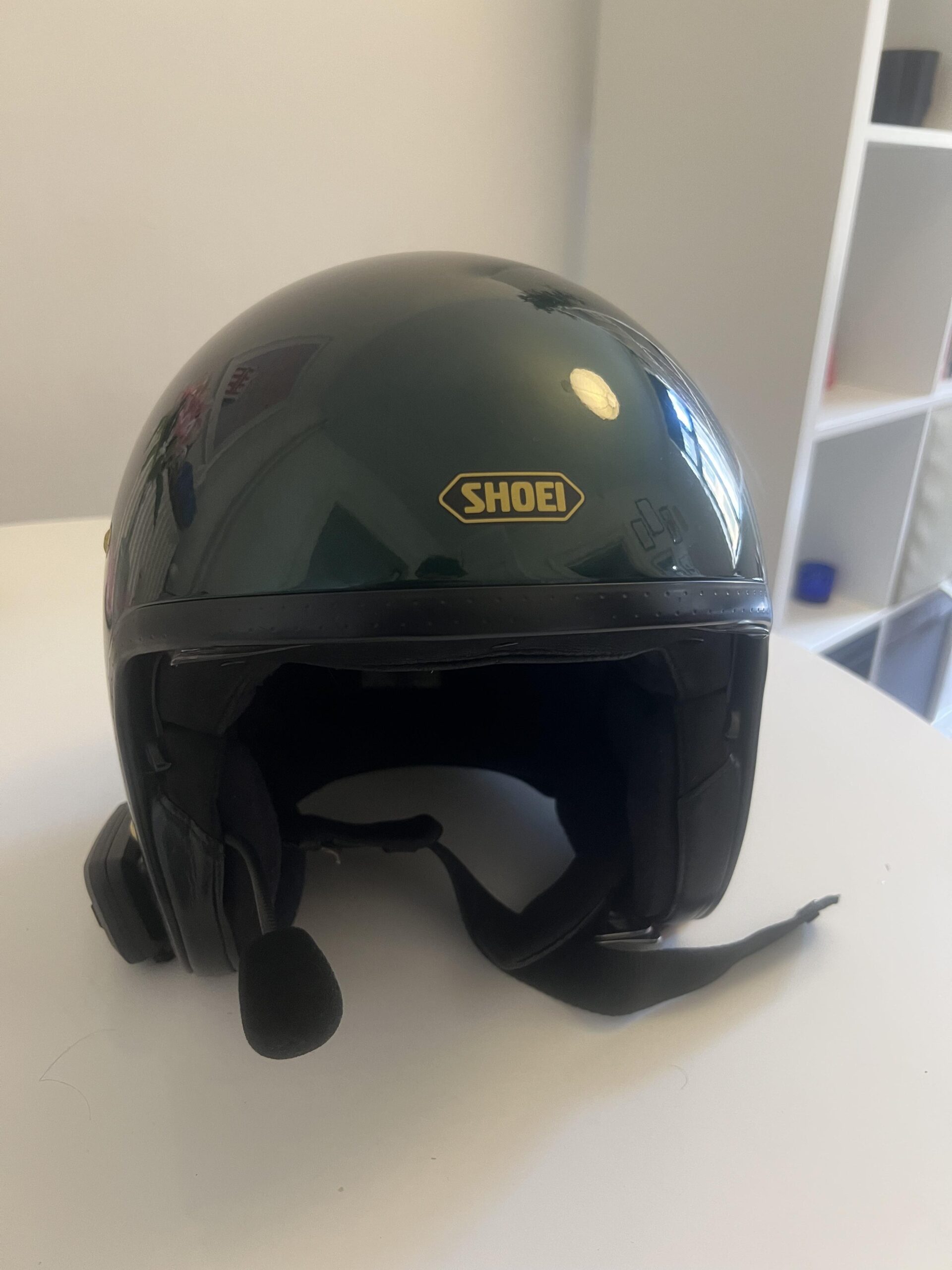
I bought my SHOEI J.O open-face helmet in British Green, size XXL, from Louis on February 27, 2024 for €319. Since then I have used it for roughly 25,000 km, possibly a little more, across two mopeds and three electric scooters, including long delivery shifts and a few days where I wore it for around 14–16 hours.
My main reason for buying it was comfort. I had previously tried a cheaper NEX Racing SV full-face helmet in size XL for about a week, and it gave me pressure points, headaches and a tired, sore neck after longer use. The SHOEI felt better almost immediately, and more than two and a half years later comfort is still the strongest reason I rate it so highly.
Important: this review is based on my own low-speed use at up to roughly 35 km/h. I have not crash-tested this helmet, and I cannot judge high-speed motorcycle noise or aerodynamics from personal experience.
SHOEI J.O British Green — 4.8/5
Quick verdict: The most comfortable helmet I have owned. After roughly 25,000 km, it still fits well, the original visor and hardware work properly, the paint looks very good, and I can wear it for exceptionally long days without helmet-related headaches or neck pain.
Best for: urban scooter and moped riders who prioritize comfort, peripheral vision, an open-face feel and premium build quality.
Skip if: you want maximum chin/face coverage, an integrated sun visor, or a cheaper helmet. I also cannot personally judge it for high-speed motorway riding because my use has been at up to about 35 km/h.
- Exceptional long-session comfort
- No meaningful pressure points or neck fatigue in my use
- Excellent peripheral visibility and shoulder checks
- Very good durability after roughly 25,000 km
- Clear visor remains smooth, stable and nearly scratch-free
- Easy Cardo Spirit HD installation
- Works well for me from roughly -5°C to 25–30°C
- Expensive — I paid €319
- Open-face design leaves the chin and much of the face exposed
- No integrated sun visor
- There is still noticeable wind noise, especially in strong wind
- Rain or snow on the clear visor can reduce visibility
My test facts
- Exact helmet: original SHOEI J.O, British Green, size XXL
- Purchased: February 27, 2024
- Retailer: Louis
- Price paid: €319
- Head circumference: approximately 61.5 cm
- Estimated distance: roughly 25,000 km, possibly a little more
- Vehicles: two mopeds and three electric scooters
- Main use: delivery work and everyday riding
- Longest days: a few days around 14–16 hours wearing the helmet
- Personal speed range tested: up to roughly 35 km/h
- Temperature range: approximately -5°C to 25–30°C
- Crash history: no road crash or drop that I can remember
- Parts replaced: none — visor, liner, cheek pads, strap and hardware are still original
This is a first-hand long-term ownership review, not a laboratory test. My comments about comfort, wind, temperature, visibility and durability reflect my own head shape, XXL fit, low-speed riding and delivery-work use.
Which SHOEI J.O is this?
This review is about the original SHOEI J.O, not the newer J.O2 that replaced it. The original J.O used SHOEI’s AIM shell construction, a multi-density EPS liner, the retractable CJ-3 clear visor, a Double-D closure and three outer shell sizes. Retailer specifications for the original model list ECE 22.05 approval and roughly 950–1,000 g depending on source and size.
The current SHOEI J.O2 is a successor, not the helmet I tested. SHOEI lists the J.O2 with ECE 22.06 homologation, a CJ-4 visor, four shell sizes and a stated weight of 1,150 g. I would consider the J.O2 if I needed a replacement, but I have not used it and I am not transferring my 4.8/5 rating to the newer model.
Why I bought the J.O after a bad experience with a cheaper helmet
Before the SHOEI, I used a NEX Racing SV matte-black full-face helmet in size XL for about a week. It cost around 600 DKK. I bought the SHOEI because the NEX was uncomfortable enough that I wanted to try two things at once: an open-face design and a better-known, more premium brand.
The difference was obvious immediately. The NEX felt tight in several places as soon as I put it on, and after longer use it could give me headaches and a sore, tired neck. The SHOEI felt right within the first 10–30 minutes.
| My comparison | SHOEI J.O XXL | NEX Racing SV XL |
|---|---|---|
| Comfort | 5.0/5 — extremely comfortable even on long days | 2.0/5 — uncomfortable with headaches during my short test period |
| Neck load | 5.0/5 — I normally do not notice the helmet’s weight on my neck | 2.0/5 — after hours it felt almost like I had trained my neck with weights |
| Pressure points | 5.0/5 — no meaningful pressure points for me | 3.0/5 — noticeable tight areas |
| Wind noise | 3.5/5 in my low-speed use | 3.0/5 in my short use |
| Peripheral visibility | Much better for me, especially side vision and shoulder checks | More restricted in comparison |
| Helmet type | Open face | Full face |
This is not a controlled safety or acoustic test. They are different helmet types and I did not measure their actual weights. It is simply the practical difference I felt while wearing both.
Comfort is the reason I still love it after ~25,000 km
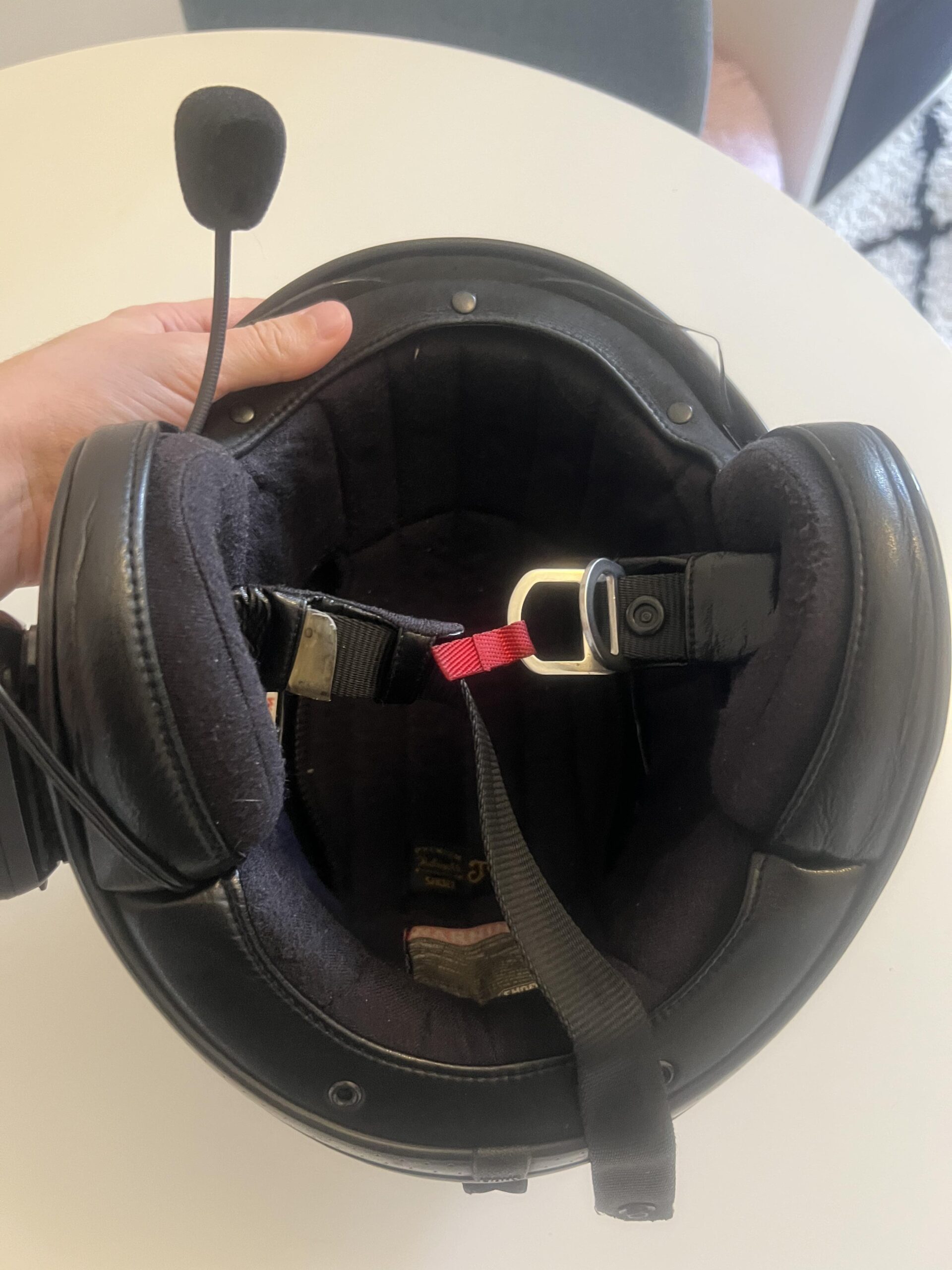
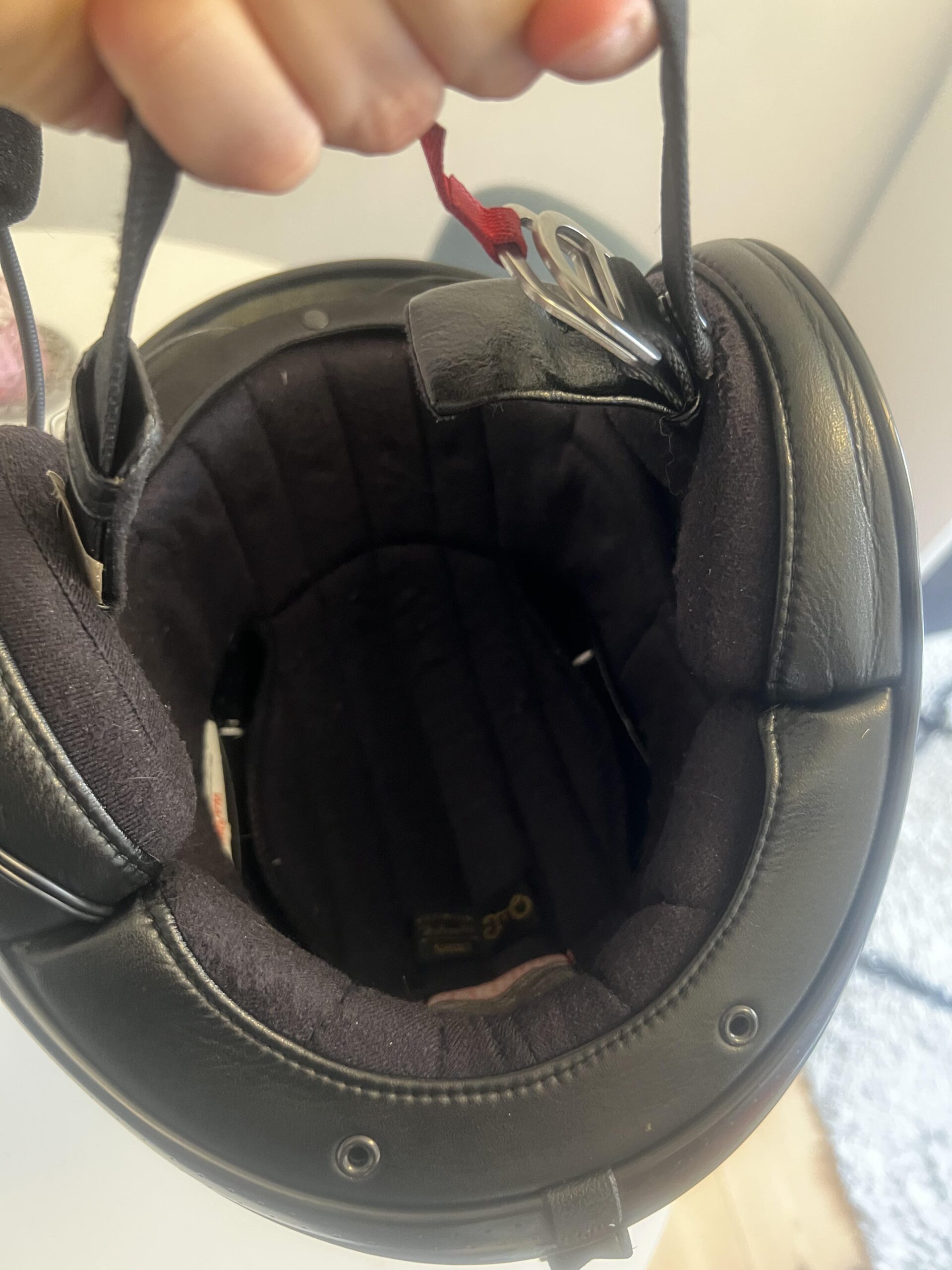
Comfort is the J.O’s biggest strength for me. I have worn it through normal rides, delivery shifts and a small number of exceptionally long days where I had it on for around 14–16 hours. I still do not get helmet-related headaches, neck pain or obvious pressure points.
My head circumference is around 61.5 cm. Size charts for the original J.O typically put 61–62 cm in XL and 63–64 cm in XXL, yet I bought XXL online without trying the helmet first. It has worked extremely well for my head shape and has not become noticeably loose.
After roughly 25,000 km, the original padding is no longer factory-fresh. I can see some flattening and wear, but it still feels comfortable and supportive.
Peripheral vision was an unexpected upgrade
I expected an open-face helmet to feel less enclosed. I did not expect the visibility difference to matter as much as it does.
Compared with the NEX full-face helmet, I can see substantially better toward the sides, and shoulder checks feel easier. For urban riding, where I am constantly watching cyclists, cars, pedestrians and junctions, that wider sense of vision is one of the J.O’s biggest practical advantages.
I also like it for delivery work because customers can see my face, communication feels easier, I can hear the surroundings better and I do not need to remove the helmet just to speak to someone.
Wind noise and wind pressure at 30–35 km/h
There is wind noise. It is an open-face helmet, and in strong wind I definitely hear it. But at the 30–35 km/h speeds I have personally tested, it does not bother me much.
The SHOEI is a little better than the NEX was for me in this area, although the difference is nowhere near as dramatic as the comfort difference. I usually listen to music through my Cardo Spirit HD, and I can hear it clearly at my normal speeds.
I also do not notice the helmet lifting or tugging at my head when I turn to look sideways.
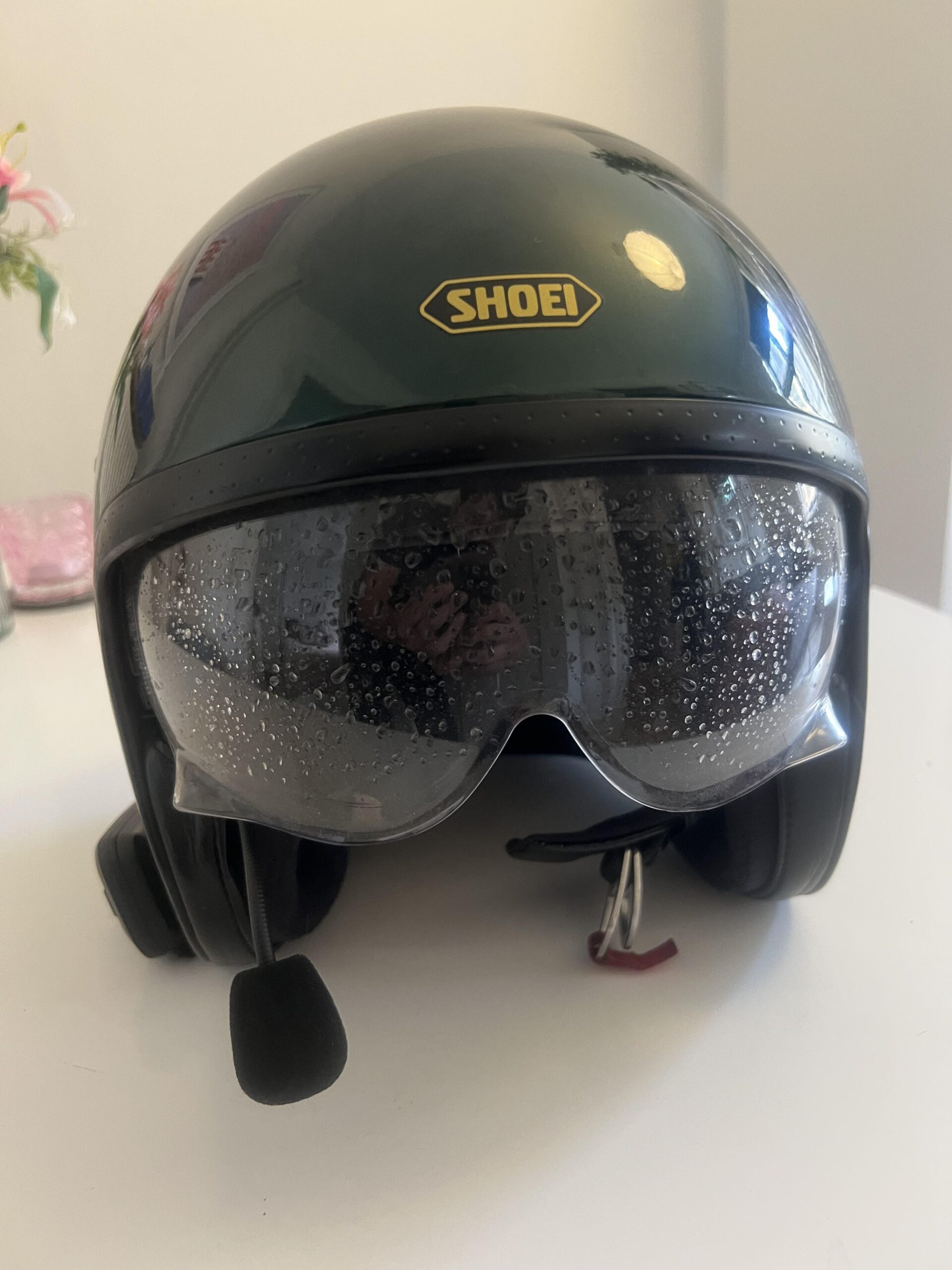
The clear CJ-3 visor is useful, but I often ride with it up
The retractable clear visor still works very well after roughly 25,000 km. It is easy to pull down or push away, including with gloves, it stays in the position I choose, and mine remains almost free from visible scratches.
I mainly use it when there is strong wind or when I want eye protection from dust, small debris, branches or similar things in the air. I also sometimes use it in heavy snow.
Rain is more complicated. I generally see better with the visor up because water droplets build up on the surface and reduce visibility. Snow can create the same problem. I have not had a major fogging problem; for me, the limiting factor is usually water or snow sitting on the outside rather than condensation.
Year-round comfort from around -5°C to 25–30°C
I use the J.O all year. My rough real-world range has been from around -5°C up to 25–30°C.
In summer, airflow is a major benefit. Even on warmer days, I rarely find the helmet itself too hot. If anything, I can get sweatier while walking up stairs during delivery work than while moving on the moped because the open-face design lets in so much air.
In cold weather, the helmet itself remains comfortable. The parts that become cold are mainly the areas the helmet does not cover. I sometimes use a neck gaiter, including under the chin-strap area.
Removable padding makes cleaning practical
After enough warm-weather use, especially when I had been climbing many stairs and sweating, the liner could develop some odor. The removable padding is easy to take out using the snap system, and washing it has restored it well.
I would treat my cleaning experience as evidence that the removable design is practical, not as a care-method recommendation. Follow SHOEI’s current instructions for washing and drying the interior components.
Double-D closure: simple, secure-feeling and still original
I like the Double-D closure. It required very little adjustment to get used to, it is fast for me now and it has never rubbed or irritated my neck even after long shifts.
The one minor inconvenience is bulky winter gloves. I normally have to remove them to fasten or release the strap. With bare hands or lighter gloves, I barely think about the closure.
Cardo Spirit HD installation and long-day ear comfort
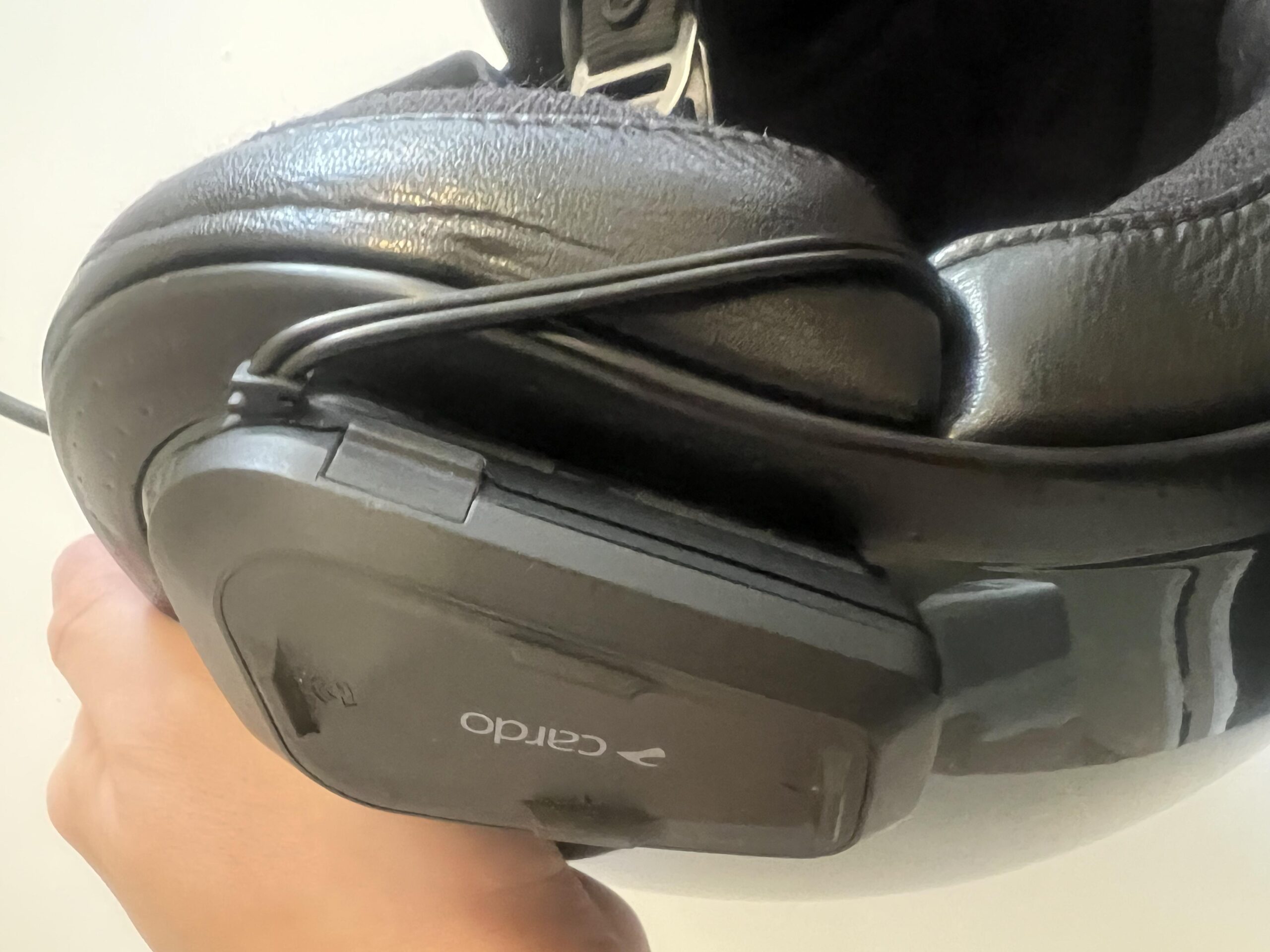
I installed a Cardo Spirit HD myself. It fit without cutting or modifying the helmet, and there was enough room for the speakers.
Most of the time I do not notice the speakers. On very long days, my ears can eventually become slightly tender where the speakers sit. The other long-day comfort issue comes from sunglasses: after perhaps 8–10 hours, the arms can start pressing around my ears. Those are accessory-related pressure points rather than problems I experience from the helmet shell or liner itself.
Durability: everything important is still original
After more than two and a half years and roughly 25,000 km, nothing important has broken, cracked or come loose.
- Original visor: still fitted and almost scratch-free
- Original liner and cheek pads: still fitted, with some visible wear and flattening
- Original Double-D strap: still working normally
- Original snaps/hardware: still intact
- No repairs or replacement parts so far
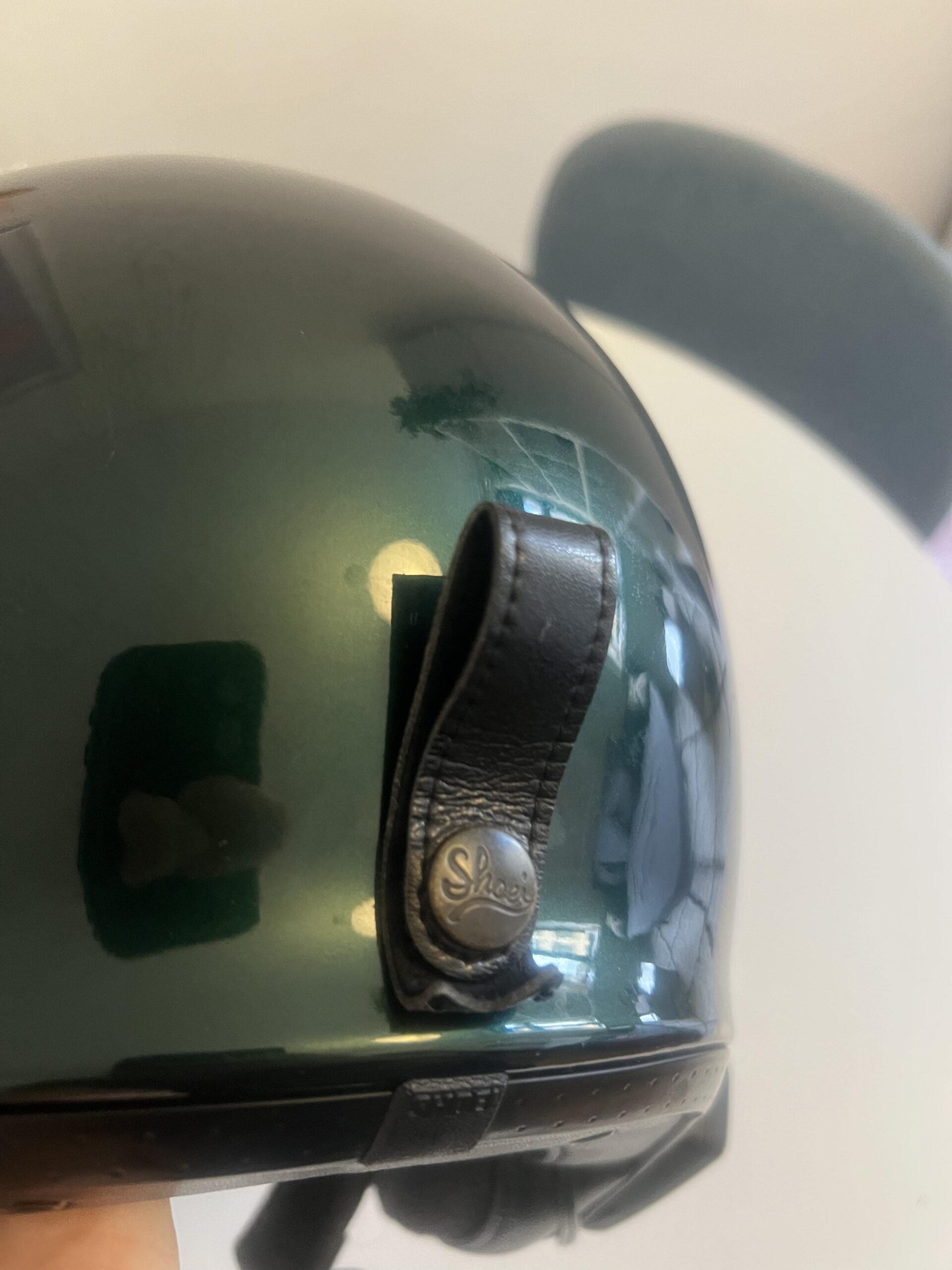
I would rate the British Green finish around 9/10 compared with new. I have bumped the helmet against ceilings and walls a number of times while walking, which has sometimes transferred paint or left small cosmetic scratches. Most marks cleaned away; a few scratches remain. These were not road crashes, and I do not treat them as evidence of crash protection.

Safety and the open-face trade-off
The original J.O was sold as an ECE 22.05 open-face motorcycle helmet. SHOEI’s published specification includes an AIM shell, a multi-density EPS liner and a Double-D retention system.
Personally, I feel comfortable using the open-face design at my normal 30 km/h moped speeds, and I value the airflow, visibility and ability to communicate with my face visible. But an open-face helmet does not cover the chin and face in the way a full-face helmet does. If maximum face and jaw coverage is your priority, this design is the wrong trade-off regardless of how comfortable it is.
I have not had a road crash in this helmet, so I cannot claim first-hand impact performance or say that it protects better than my old NEX. My comparison is about comfort, fit, visibility, perceived build quality and everyday use.
Is the SHOEI J.O worth €319?
For me, yes.
€319 felt expensive when I bought it, and price is still my biggest criticism. But I bought it because a cheaper helmet was uncomfortable enough that I did not want to keep wearing it. More than two years and roughly 25,000 km later, the SHOEI has delivered exactly what I hoped the premium price would buy: comfort, excellent long-term usability and very good build quality.
If mine needed replacing tomorrow, I would research the market again rather than blindly ordering the same helmet. I would look closely at the J.O2, compare cheaper open-face alternatives and try more sizes in person. But I would almost certainly stay with an open-face helmet because comfort and visibility matter so much in my type of riding.
Why I rate the SHOEI J.O 4.8/5
My overall rating is 4.8/5. This follows the public JonTests rating method: I use criteria that matter for this product, weight them to 100%, score them from documented evidence and round the weighted result to one decimal place.
| Criterion | Weight | Score | Why |
|---|---|---|---|
| Comfort & long-session wear | 25% | 5.0/5 | Comfort remains excellent after ~25,000 km, including rare 14–16-hour days, without helmet-related headaches or neck pain. |
| Durability & build quality | 20% | 4.9/5 | No broken or replaced parts; original visor, liner, strap and hardware still work. Only minor cosmetic wear and liner flattening. |
| Fit & pressure management | 15% | 5.0/5 | XXL fits my 61.5 cm head extremely well in practice with no meaningful pressure points and no obvious loosening. |
| Visibility & everyday usability | 15% | 4.9/5 | Excellent peripheral vision, easier shoulder checks, good communication for delivery work and easy use with sunglasses. |
| Visor & weather usability | 10% | 4.3/5 | Mechanism remains excellent and the visor is nearly scratch-free, but rain/snow droplets can reduce visibility. |
| Value for money | 10% | 4.4/5 | €319 is expensive, but the comfort and durability have justified it for me over heavy long-term use. |
| Wind noise | 5% | 3.5/5 | Noticeable wind noise remains, especially in strong wind, although it is acceptable at my 30–35 km/h speeds. |
| Weighted rating | 4.8/5 | 4.76 before rounding. | |
Who should buy it?
- Good fit: scooter or moped riders who prioritize comfort and wide peripheral vision.
- Good fit: urban riders who like the airflow and communication advantages of an open-face helmet.
- Good fit: riders willing to pay more for comfort and premium-feeling construction.
- Consider something else if: maximum chin and facial coverage is a priority.
- Consider something else if: you specifically want an integrated sun visor.
- Consider something else if: your main use is high-speed motorway riding. I have not personally tested the J.O at those speeds.
- For cycling: I personally would choose a normal bicycle helmet rather than the J.O.
Would I buy it again?
I would buy this type of helmet again, but I would shop around first.
If my J.O had to be replaced, I would investigate the newer J.O2 and other open-face helmets, compare prices, and try more than one size. I would still prioritize comfort, fit and visibility over saving a relatively small amount of money.
If a friend asked for my one-line verdict, I would say: it is a very comfortable helmet, easy to use and worth the money.
Frequently asked questions
How many kilometers have you used the SHOEI J.O?
My estimate is roughly 25,000 km, possibly a little more, across two mopeds and three electric scooters since February 2024.
Is the SHOEI J.O comfortable for long rides?
For my head shape, yes. I have used it on rare 14–16-hour days without helmet-related headaches, neck pain or meaningful pressure points. Fit is personal, so that does not guarantee the same result for another rider.
What size SHOEI J.O do you wear?
I wear XXL with a head circumference around 61.5 cm. That is larger than standard charts would normally suggest. I never tested XL, so I would not recommend copying my size choice without trying both.
Does the SHOEI J.O work with sunglasses?
Yes for me. I wear sunglasses regularly. After 8–10 hours the arms can eventually make the area around my ears slightly tender.
Can you install a Cardo Spirit HD?
I did. Mine fit without helmet modification and there was space for the speakers. On exceptionally long days I can sometimes feel the speakers against my ears.
Does the clear visor fog?
I have not had a meaningful fogging problem. My bigger issue in bad weather is rain or snow collecting on the outside and reducing visibility.
Is the SHOEI J.O good for motorcycles?
It is an open-face motorcycle helmet, but my own test experience is limited to roughly 35 km/h. I therefore cannot give a first-hand verdict on motorway-speed noise, aerodynamics or long-distance high-speed riding.
What is the difference between the J.O and J.O2?
My tested helmet is the original ECE 22.05 J.O with a CJ-3 visor and three shell sizes. The current J.O2 is a newer ECE 22.06 model with a CJ-4 visor and four shell sizes. I have not tested the J.O2.
Sources and review method
- My own purchase from Louis on February 27, 2024, roughly 25,000 km of use, seven original current photos and the first-hand observations documented above.
- SHOEI Europe original J.O catalog information for AIM shell, EPS liner, CJ-3 visor, Double-D closure, shell sizes and removable padding.
- FC-Moto original J.O listing for ECE 22.05, CJ-3 and approximately 1,000 g (+/- 50 g) specification context.
- RRmoto exact British Green listing for original color/variant identity and the published XL/XXL size chart.
- SHOEI Europe J.O2 page for current-successor specifications. The J.O2 is not part of my hands-on test.
- JonTests — How I Test for the public rating methodology.