Botanic Hearth Rosemary Hair Oil Review: 11 Months on Dry Scalp
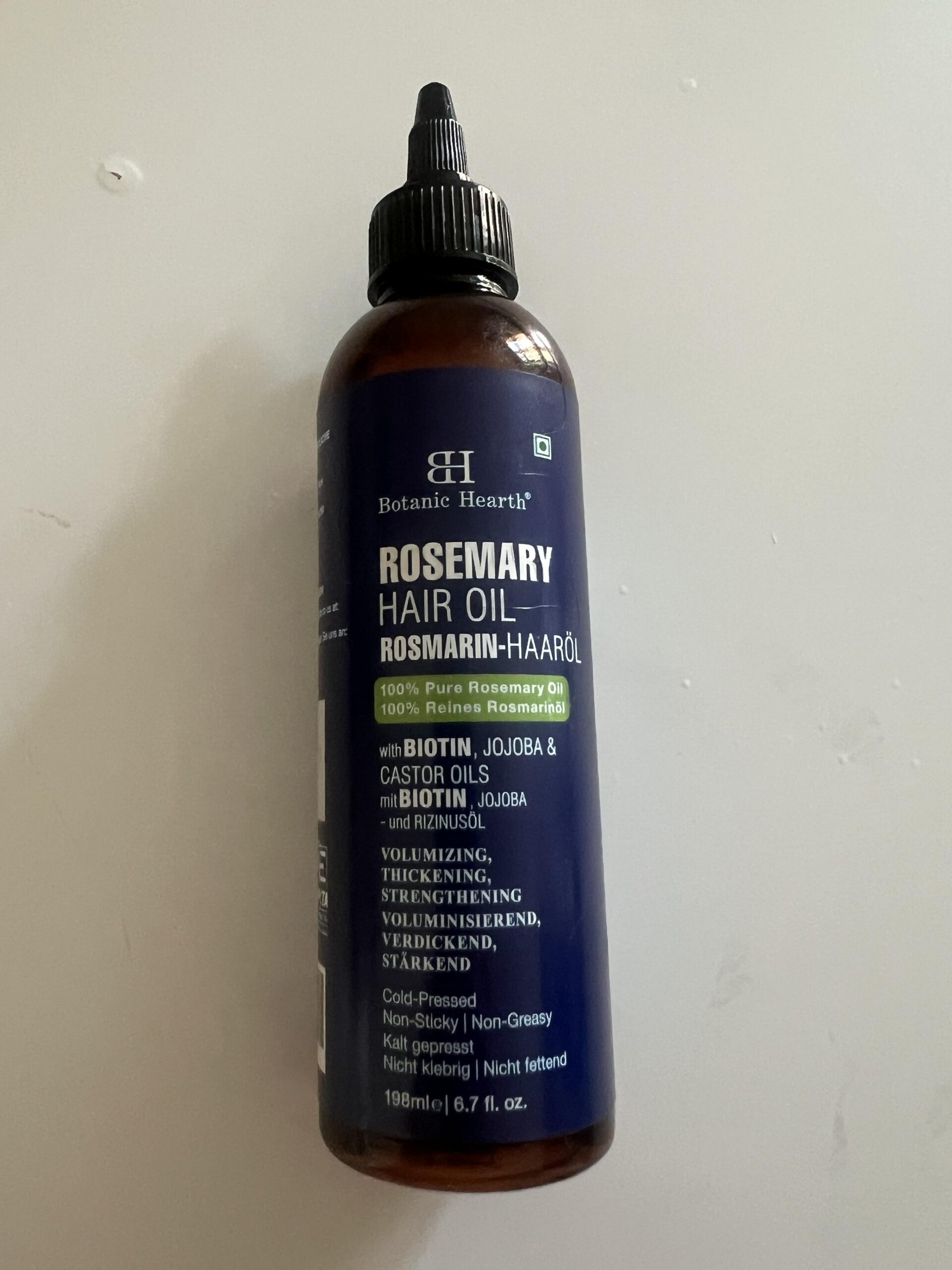
My Botanic Hearth Rosemary Hair Oil review after roughly 11 months of ownership: 4.6/5 for scalp care—not a proven hair-regrowth treatment. I bought the 198 ml (6.7 fl oz) bottle on November 16, 2025, for €12.99 with my own money, without a discount or compensation. I was not trying to test a miracle hair-growth claim. I wanted to make my unusually dry, uncomfortable scalp feel better. In my experience, it has done that very well.
My hairdresser first pointed out that my hair and scalp looked very dry. I also use hair-loss treatment, including minoxidil, and wondered whether it could be contributing to dryness, irritation and occasional itching. I cannot establish the cause or diagnose a scalp condition. What I can say is that, on the occasions I used this oil, my scalp felt more comfortable, less itchy and less irritated. I also enjoy the scent. The trade-off is that my hair looks somewhat darker and greasier while the oil is in it.
Affiliate disclosure: This article contains a paid Amazon link. As an Amazon Associate I earn from qualifying purchases, at no additional cost to you. I bought the bottle myself, with no discount, sponsorship, gifted product or compensation. My rating reflects my experience rather than an Amazon customer average. Read the full affiliate disclosure.
My use: ~11 months owned · ~2–3 times weekly as needed
I paid: €12.99 for 198 ml (November 2025)
Paid link · Exact photographed 198 ml variant · ASIN B0C6XJMSGP
My quick verdict
Very good for what I personally bought it for: calming the feeling of a dry, itchy scalp and leaving my hair pleasantly conditioned. I noticed less irritation after applying small amounts. The fragrance is particularly enjoyable to me—my partner noticed it positively too.
Best for: someone looking for a fragranced, economical oil blend to condition dry hair and scalp, who does not mind an oily finish.
Skip if: you need a non-greasy daytime finish, avoid essential oils or scents, have an inflamed scalp that needs assessment, or expect proof of new hair growth.
What I liked
- Noticeably improved my scalp comfort
- Excellent scent in my opinion
- Small amounts spread well
- Easy to dispense and shampoo out
- Large bottle for my €12.99 purchase price
What to know
- Makes hair look darker and somewhat greasy
- No proven hair-regrowth outcome from my use
- Fragrance/essential oils will not suit everyone
- My inconsistent schedule cannot establish precise longevity
Bottom line: I would buy Botanic Hearth Rosemary Hair Oil again for dry-scalp comfort, scent and value. My 4.6/5 score measures those personal-use benefits—not clinically demonstrated hair regrowth.
Why I bought it: my hairdresser noticed a dry scalp
I originally went looking for a hair oil after a hairdresser told me that my scalp and hair appeared very dry. At the time I was also dealing with occasional itching and irritation. Because I use minoxidil among other hair-loss products, I suspected the treatment routine might be contributing, but I did not perform any medical testing to work that out.
I bought this bottle with a straightforward goal: make the scalp feel less dry and more comfortable. I did not choose it to replace minoxidil, measure hair density or chase a quick hairline change.
Did Botanic Hearth Rosemary Oil help my dry scalp?
Yes, in my personal experience. This is the main reason I am positive about it. When I feel dryness or mild irritation starting, applying a modest amount of the oil makes my scalp feel better. I notice less itching and discomfort after application. I have not noticed a need to saturate my hair or empty large amounts from the bottle.
The limitation matters: I used it when symptoms bothered me, without keeping a symptom diary, and I also used other hair products and treatments. This is an honest account of perceived comfort, not proof that rosemary oil treats dermatitis, reverses a minoxidil side effect or improves every type of itchy scalp.
How I used it: palms first, scalp second
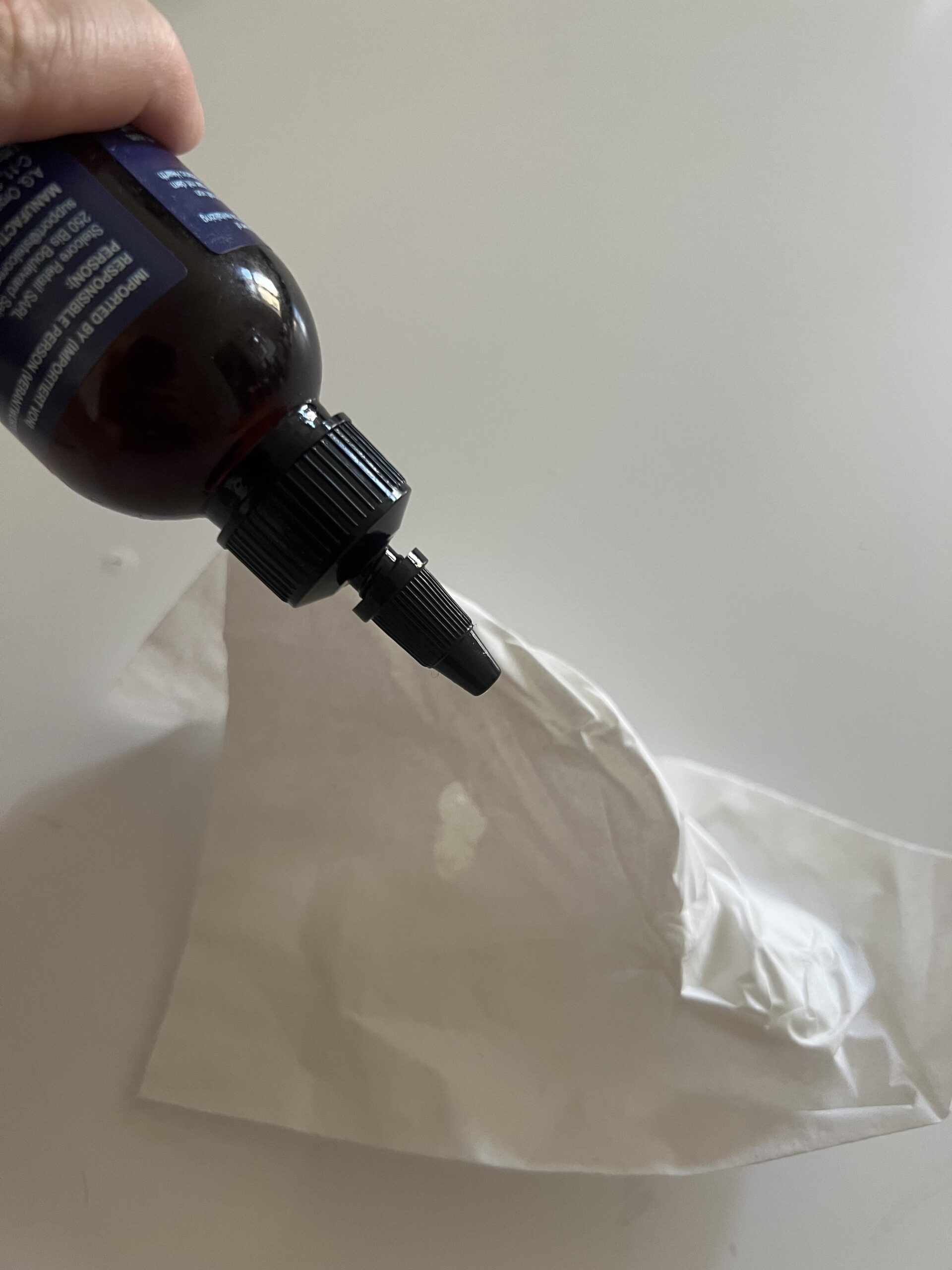
Although the bottle has a pointed applicator, my actual routine was to squeeze a little oil into my hand, spread it over the scalp and then work any remaining oil through the hair. I used it sporadically, approximately two or three times a week when I felt dry or irritated. I often left it in until the next time I shampooed, sometimes several days later. That is a description of what I personally did, not a tested optimum application schedule.
I found the nozzle easy to control. The oil felt relatively easy to spread and was simple to remove with shampoo when I eventually washed my hair. It left a pleasant conditioned feel for me, but did not disappear visually: my normally brown hair looked notably darker, almost black, and a little greasy while wearing it.
What is actually in this ‘100% Pure Rosemary Oil’ bottle?
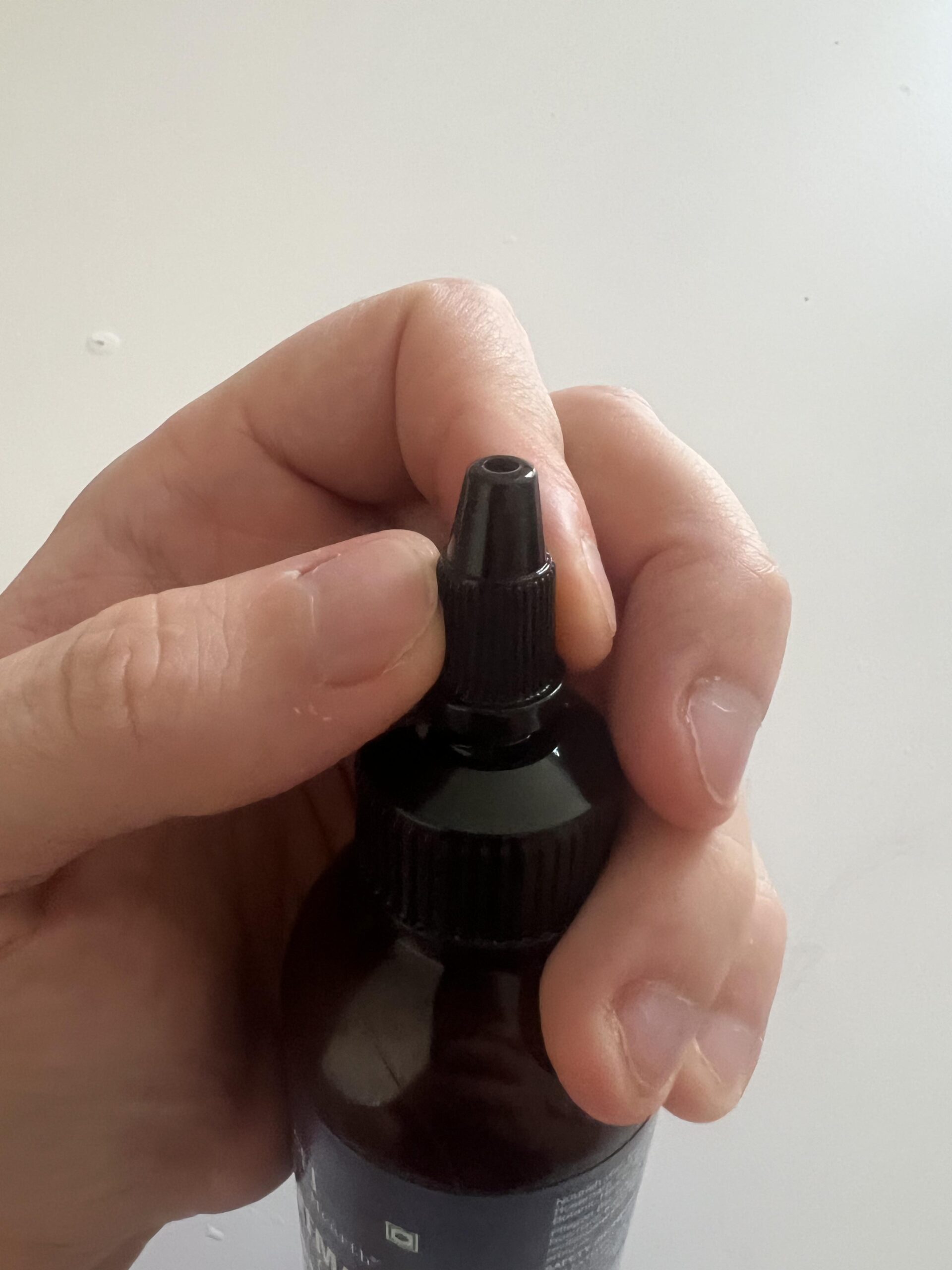
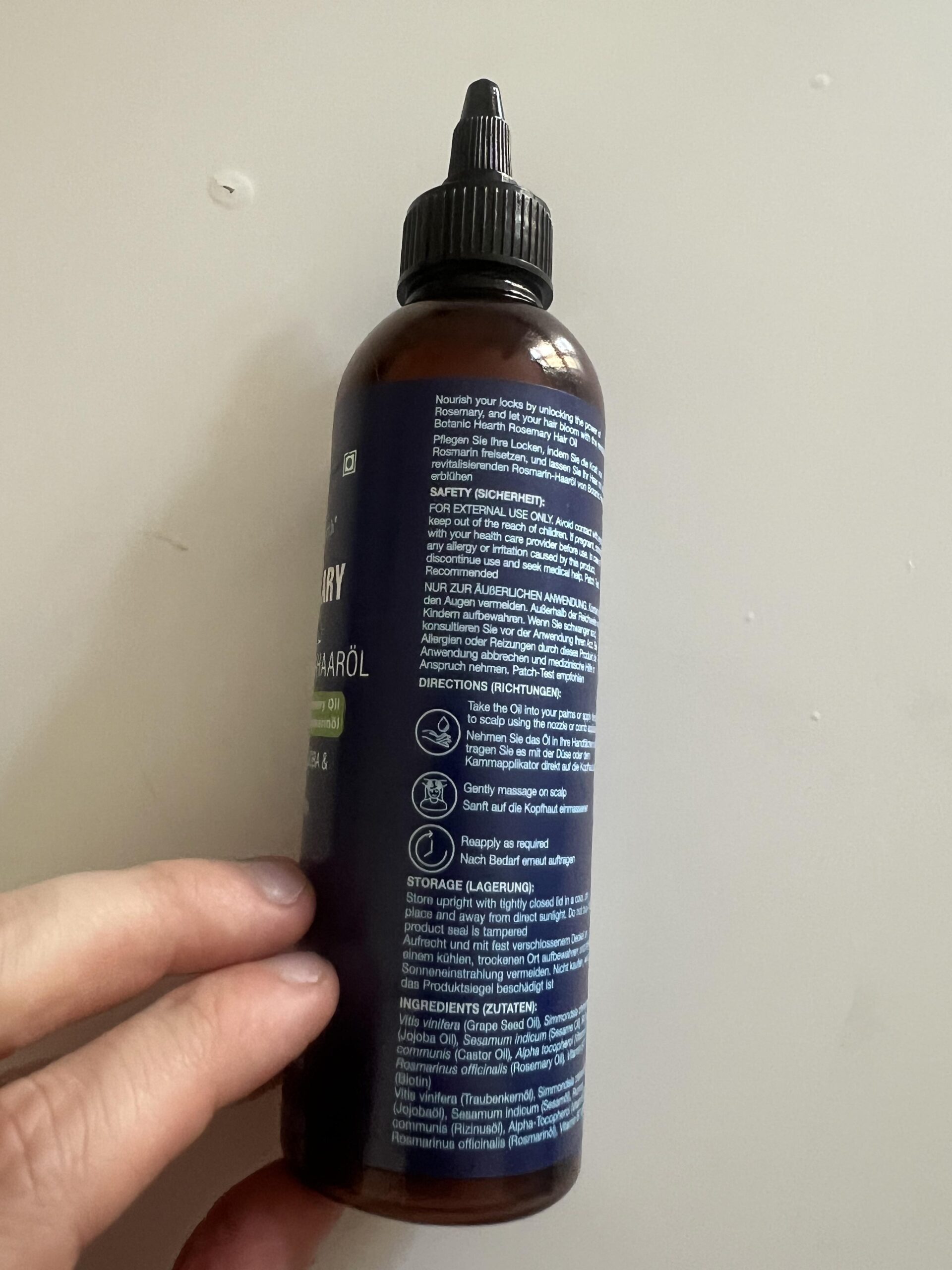
Despite the prominent 100% Pure Rosemary Oil wording on the front of my bottle, this is not a bottle containing only undiluted rosemary essential oil. The 198 ml product is a multi-ingredient hair oil blend. The ingredient information on my packaging and Botanic Hearth’s 6.7 fl oz product page identifies grapeseed oil, jojoba oil, sesame oil, castor oil, vitamin E, rosemary oil and biotin. The exact percentages are not given in the material I verified.
I appreciate having an oil blend ready to use rather than needing to blend pure essential oil myself. But I cannot independently rate individual ingredient purity, concentrations, clinical effectiveness or superiority over every competing formula. Essential oils can also irritate sensitive skin; a product marketed as natural is not automatically risk-free.
Does this oil grow hair? I cannot honestly tell
I used other hair-loss products at the same time, did not track hair counts and did not buy this oil for regrowth. I cannot attribute any hair-growth changes—or a lack of change—to Botanic Hearth Rosemary Hair Oil. My high rating therefore applies to scalp comfort, scent, handling and value, not a verified growth result.
There is interesting but limited research on rosemary oil itself. A 2015 randomized trial involving 100 people with androgenetic alopecia compared a rosemary-oil preparation with 2% minoxidil over six months. Both groups had higher measured hair counts by six months, without a statistically significant difference between groups. That does not prove that this particular commercial blend grows hair, that it matches modern 5% minoxidil treatments, or that one study settles its efficacy. The study also did not show meaningful improvement in hair counts at three months.
For additional context, my separate Australian Bodycare Hair Loss Spray review discusses another first-hand hair-product experience. These are different products with different aims and should not be treated as equivalent hair-loss treatments.
Minoxidil, dry scalp and essential-oil safety
It is plausible for topical hair-loss treatments to be associated with scalp irritation in some people. A systematic review of confirmed allergic contact dermatitis associated with topical minoxidil products found that reactions can involve minoxidil itself or other ingredients in a formulation. My experience does not establish which, if any, ingredient caused my own symptoms.
If you use minoxidil or another scalp medication, do not assume an oil is a treatment for drug-related irritation or that combining the products is harmless. Follow your medication’s instructions, avoid applying products to damaged or severely inflamed skin, and ask a pharmacist or dermatologist how to space applications if unsure. Stop a new oil if it worsens itching, redness or burning; patch-test first if you are sensitive. Persistent scalp symptoms deserve professional assessment.
How long does a 198 ml bottle last?
I paid €12.99 for 198 ml on November 16, 2025: about €6.56 per 100 ml at that historical price. Nearly 11 months later, my rough estimate was that I still had at least about half a bottle. That supports good value for my occasional small-amount routine, not a claim that every user will get a full year from one bottle. I did not measure millilitres per application, and this is not a current retail-price quote.
Compared with other hair oils I have previously tried, I prefer this one’s fragrance and price-to-amount balance. That preference is personal; I did not run a controlled head-to-head or verify the exact ingredients and prices of every older product.
Alternatives worth considering
| Product | Potential fit | Important difference |
|---|---|---|
| Botanic Hearth Rosemary Hair Oil, 198 ml (this review) | Fragranced scalp-and-hair oil that I found comforting for dryness | Large multi-oil blend; slightly greasy on my hair; growth effect unverified |
| Mielle Rosemary Mint Scalp & Hair Strengthening Oil | Another rosemary-based hair oil to research | The manufacturer lists peppermint, menthol and other aromatic ingredients. This may not suit everyone with a sensitive scalp; I have not personally compared it. |
| The Ordinary 100% Plant-Derived Squalane | People wanting a simpler, single-ingredient conditioning product | Squalane rather than a rosemary/biotin blend; 30 ml manufacturer format. Not personally tested by me as a scalp alternative. |
These are product-category comparisons based on manufacturers’ descriptions, not first-hand rankings. If itch or scaling is persistent or worsening, finding the cause is more useful than cycling through aromatic oils.
How I calculated my 4.6/5 rating
This is JonTests’ own editorial score for my documented use case, not an Amazon rating, a laboratory measure, a treatment-effect estimate or a claim about hair growth. I scored only aspects I had enough direct experience to evaluate. Because I did not isolate or measure hair regrowth, I excluded it instead of assigning a speculative number.
| Criterion | My score | Weight | Why |
|---|---|---|---|
| Scalp comfort and perceived relief | 4.8/5 | 40% | My main buying reason: noticeably less dry, itchy and uncomfortable scalp in my experience. |
| Scent and sensory experience | 4.8/5 | 20% | My favourite scent among the hair oils I have used; my partner noticed it positively too. |
| Application and washing out | 4.4/5 | 15% | Easy to dispense, spread and shampoo out, although it leaves some oiliness. |
| Value for money | 4.7/5 | 15% | I paid €12.99 for 198 ml and still had about half the bottle after intermittent use. |
| Appearance after application | 3.8/5 | 10% | Hair feels pleasantly conditioned to me, but it looks darker and somewhat greasy. |
Weighted calculation: (4.8 × 40%) + (4.8 × 20%) + (4.4 × 15%) + (4.7 × 15%) + (3.8 × 10%) = 4.625/5, rounded to 4.6/5. The biggest weight goes to perceived scalp comfort because that was the reason I bought the product. The oily cosmetic finish keeps the score from being even higher.
Who should buy it—and who should skip it?
Consider it if a pleasant-smelling hair oil for occasional dryness is your main goal, you want a generous bottle, and you are comfortable with a slightly oily look between shampoos. I would repurchase it for precisely those reasons.
Consider something else if you want an oil-free hair style, have known sensitivity to rosemary or scented products, need evaluation for a persistently inflamed scalp, or are hoping for a proven stand-alone treatment for pattern hair loss. For those purposes, my experience does not establish that this product is the right solution.
Frequently asked questions
Did it cure the itch caused by minoxidil?
No such causal claim is possible. I noticed less itching and dryness after applying the oil, but I never established whether minoxidil caused my symptoms or whether the oil would work for someone else. Continued irritation should be discussed with a healthcare professional.
Does Botanic Hearth Rosemary Hair Oil leave hair greasy?
Somewhat, yes. My hair looked darker and visibly more oily after application, though I personally found it comfortable rather than unpleasant.
Can I use it without washing it out immediately?
I often left it in until my next shampoo, sometimes for several days. That describes my personal usage, not a universal recommendation. Follow current package directions, pay attention to scalp comfort, and use less or wash it out sooner if your skin or hair dislikes it.
Is it actually pure rosemary essential oil?
No—it is a blend that includes rosemary alongside other oils and added biotin, as the product ingredient information confirms. Do not confuse the front-label wording with a single-ingredient undiluted essential oil.
Is it worth €12.99?
It was for me. That is the price I actually paid for my 198 ml bottle in November 2025, not a current Amazon quote. After nearly 11 months of intermittent use, I still had a substantial amount left.
My final verdict
I will happily buy Botanic Hearth Rosemary Hair Oil again, but as a scalp-conditioning product. I like the scent, the easy application, the modest amount needed and especially how much better my dry scalp feels after I use it. Its slightly greasy appearance is a real compromise. As for hair growth, I have no reliable conclusion—and I would not turn an uncertain bonus into the main reason to buy.
Sources and review method: My own purchase and use since November 2025; my original photographs of the exact 198 ml bottle; Botanic Hearth’s ingredient/product information; Panahi et al. (2015), rosemary oil and 2% minoxidil randomized trial; minoxidil contact-dermatitis systematic review; and the linked alternative manufacturers’ own ingredient descriptions. Product and medical claims are separated from my observations. Reviewed October 2026 by Jonathan Gron.