Oatly No Sugars Oat Drink Review: 24 Litres Bought
My Oatly Oat Drink No Sugars review: 4.1/5. I bought four six-packs, 24 one-litre cartons in total, between September 13 and October 3, 2026. Each six-pack cost €13.14, so I spent €52.56 altogether, or €2.19 per litre. I started using it in September, mainly in the one or two coffees I drink each morning. My partner drinks coffee too and also uses this oat drink on muesli.
My conclusion is a little unusual: Oatly tastes better than the Alnatura Organic Oat Drink Unsweetened I used before, but I probably will not buy it again at the same price. The difference is pleasant, not life-changing, and Alnatura has cost me roughly half as much. If I mostly use oat drink as a small part of a cup of coffee, that saving matters.
Independent review and link disclosure: I bought the cartons myself; this is not a sponsored product test. The main product link goes to Oatly’s official information page and is not a paid affiliate link. I was also given an Amazon Germany product listing and shortened Amazon link, but their exact variant and redirect have not been independently confirmed, so I am not presenting either as a verified buying link for this specific No Sugars carton. I distinguish my first-hand taste observations from label information and manufacturer claims.
My experience: Daily morning coffee, occasional tea; my partner also uses it with muesli
What I paid: €13.14 per 6 × 1L pack · €2.19/L
Official manufacturer information · not a paid affiliate link · prices and availability may change
Oatly Oat Drink No Sugars (1L) — My 4.1/5 Verdict
Quick verdict: This is the better-tasting oat drink of the two I know well. I like its gentle, slightly sweet-seeming oat flavour, and it works smoothly in my morning coffee without separating. However, at €2.19 per litre it cost me roughly twice as much as the Alnatura Organic Oat Drink Unsweetened I used before. I am not convinced the extra flavour is worth that premium for something I mainly add to coffee.
Best for: People who prioritise oat flavour, a smooth pour, 0 g labelled sugars and fortified calcium, iodine and vitamins, and who are willing to pay more.
Consider an alternative if: You mainly need an affordable splash of plant milk in coffee, want strong coffee-whitening, or value the lowest cost per litre over a small taste advantage.
Would I repurchase? Probably not at the same price. I would likely return to Alnatura because it is much cheaper for my usual routine, even though I prefer Oatly’s taste.
What I liked
- Noticeably more pleasant oat flavour than my previous Alnatura drink
- Tastes slightly sweeter to me despite the 0 g sugars label
- Smooth, fairly light consistency without separation in my use
- Works in coffee, occasional tea and my partner’s muesli
- No bloating, stomach discomfort or other issues noticed
- Manufacturer-labelled calcium, iodine and vitamins D2/B12
What could be better
- €2.19 per litre was roughly twice my previous Alnatura price
- Does not whiten coffee as much as some other milks
- I cannot justify the premium as easily when using small amounts in coffee
- Not tested by me for steaming, foaming or latte art
Bottom line — 4.1/5: My taste preference is clear: Oatly wins. My buying preference is less flattering: Alnatura probably wins on value for my daily coffee. This is a good oat drink that I am unlikely to repurchase at the same price.
Why I rate Oatly No Sugars 4.1/5
My overall first-hand editorial rating is 4.1 out of 5 stars. Oatly earns high marks for its oat flavour, smooth texture and how well it fits our daily coffee-and-muesli routine. But its price was roughly double that of my previous Alnatura oat drink, and I would probably not repurchase Oatly at the same price. That is why a drink I genuinely prefer for taste still receives a more restrained overall rating.
| Criterion | Weight | My score | First-hand reason |
|---|---|---|---|
| Taste | 30% | 4.7/5 | I consistently prefer its pleasantly oat-like, slightly sweet-seeming flavour to Alnatura Organic Oat Drink Unsweetened, which I had consumed for approximately 30–40 litres before trying Oatly. |
| Performance in coffee and muesli | 20% | 4.3/5 | It tastes good in my daily morning coffee and occasional tea, and my partner likes it on muesli. It does not whiten coffee as strongly as some milks; I have not tried frothing it. |
| Texture and pouring | 15% | 4.4/5 | It is smooth, fairly light and does not noticeably separate in my use. I normally shake the carton, but have not tested whether shaking is necessary. |
| Digestive tolerance | 10% | 4.8/5 | I have not noticed bloating or stomach discomfort during our household use. This is only my own experience, not evidence of universal tolerance. |
| Price and value | 25% | 2.6/5 | My four six-packs cost €13.14 per 6L (€2.19/L). That is roughly twice what I paid for Alnatura, making it hard to justify another purchase for my coffee routine. |
Reproducible calculation: (4.7 × 30%) + (4.3 × 20%) + (4.4 × 15%) + (4.8 × 10%) + (2.6 × 25%) = 4.06/5, rounded to 4.1/5. The weights total 100%.
This is my personal, weighted editorial assessment based on the exact product I bought, used and photographed. It is not a consumer-review aggregate, a clinical nutrition score or a laboratory analysis. I did not score untested coffee frothing or assume that my digestive tolerance applies to everybody. See how I test products for the site’s first-hand evidence approach.
Four six-packs in three weeks: exactly what I bought
I did not just try a sip and write a review. I bought Oatly No Sugars in six-packs on three shopping dates, including two six-packs in a single purchase on September 19. The following figures are my actual recorded purchase prices, not today’s Amazon price.
| Purchase date | Quantity bought | Amount paid | Running total purchased |
|---|---|---|---|
| September 13, 2026 | 6 × 1 litre | €13.14 | 6 L |
| September 19, 2026 | 2 × (6 × 1 litre) | €26.28 | 18 L |
| October 3, 2026 | 6 × 1 litre | €13.14 | 24 L |
| Total | 24 × 1L cartons | €52.56 | 24 L purchased |
That works out to €2.19 per litre (€13.14 ÷ 6), with €52.56 spent across 24 purchased cartons. It does not mean I personally drank all 24 litres by the review date: my partner uses the cartons as well, and some could still be unopened. This is a household-use review rather than a controlled individual-consumption study.
How does Oatly No Sugars actually taste?
For me, the flavour is the main reason to buy it. I find it very pleasant, slightly sweeter-tasting than I expected, and more reminiscent of real oats than the Alnatura Organic Oat Drink Unsweetened I had used for a long time. The flavour is gentle rather than overwhelming, which makes it easy to drink in coffee without dominating the coffee itself.
There is an important distinction here: “tastes sweet” is a sensory description, not a claim that it contains sugar. The exact Oatly No Sugars label states 0 g sugars per 100 ml. Oat flavour, texture, other carbohydrates and my own taste perception can still make the drink seem mildly sweet to me. I did not test it with a refractometer or perform a blinded panel comparison.
I am quite familiar with Alnatura’s unsweetened oat drink because I previously went through approximately 30–40 litres of it. This is not a quick supermarket taste comparison between unfamiliar cartons. That said, the two products were not evaluated side by side at the same temperature on a fixed date, so I would not pretend to measure how much better Oatly tastes on an objective scale.
My daily test: one or two morning coffees
My normal routine is one or two cups of coffee in the morning. My partner has a similar routine, so this is where most of our Oatly No Sugars goes. I sometimes use it in tea as well. In coffee, it tastes good and does not noticeably separate in my use. The texture is fairly light rather than thick, and I have not seen it split or curdle in the way some plant milks can under certain conditions.
The one cosmetic limitation I notice is that it does not turn the coffee as white or pale as some other milks. If you judge a milk substitute by how creamy and light it makes your coffee look, this may disappoint you. I care more about the taste than the colour, so it is not a deal-breaker for me.
I generally shake the carton before pouring. That is my habit, not evidence that it needs vigorous shaking to prevent separation. I did not compare shaken and unshaken pours under controlled conditions. I also have not tried frothing, steaming, making latte art or using an espresso steam wand, so I cannot recommend this as a tested barista replacement.
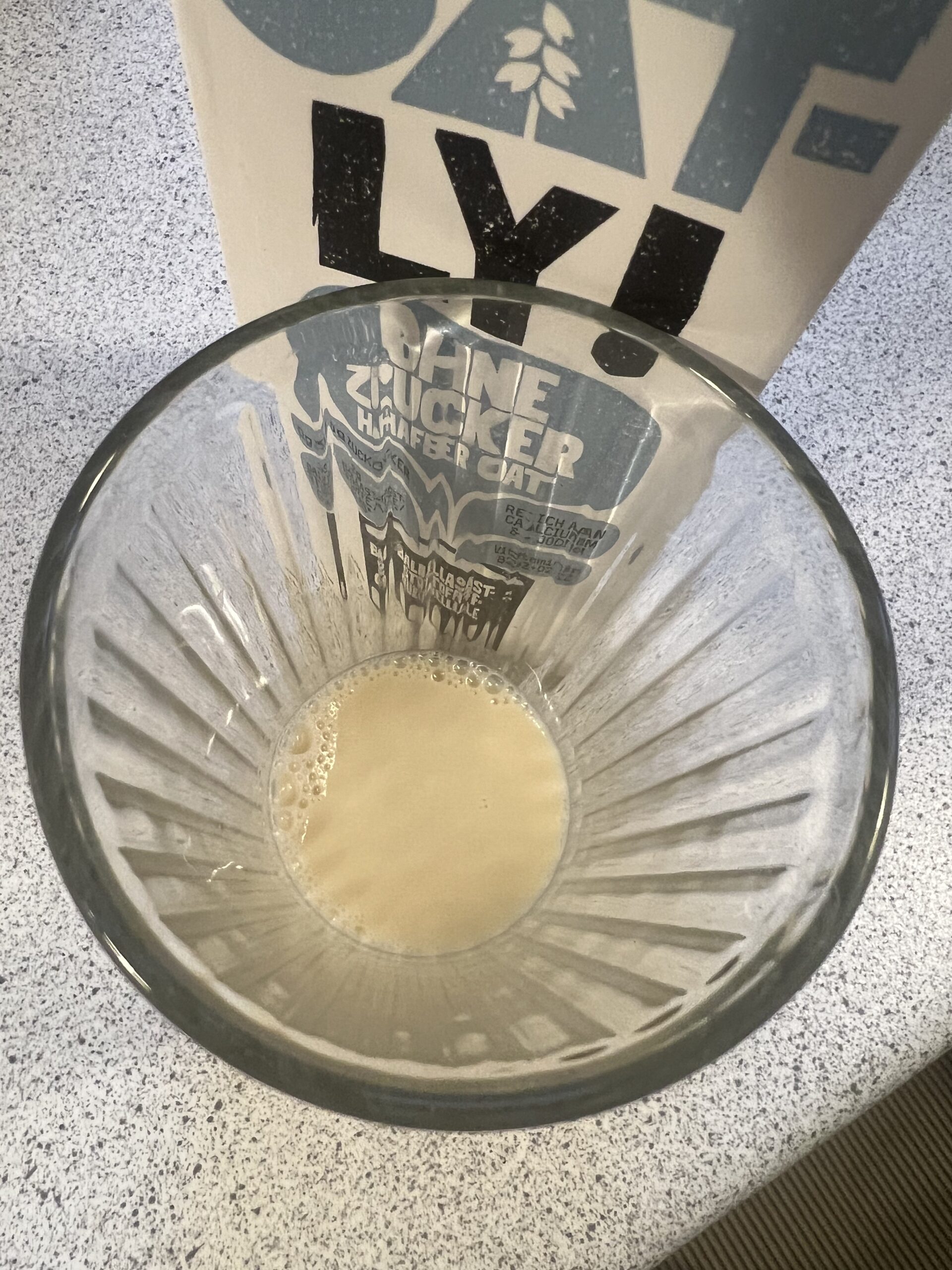
How does it work with muesli and tea?
My partner also pours it over muesli, where it works very well in our household. It has enough oat flavour to be enjoyable with cereal without becoming overly heavy. I sometimes add it to tea, and it is pleasant there too. However, our most repeated use is coffee, so I am not going to claim extensive testing in smoothies, pancakes, baking or sauces.
The product is designed for everyday use as a milk alternative. Oatly’s own instructions also mention drinking, cooking and baking, but those are suggested uses from the manufacturer, not things I personally tested in this review.
Texture, digestion and the carton
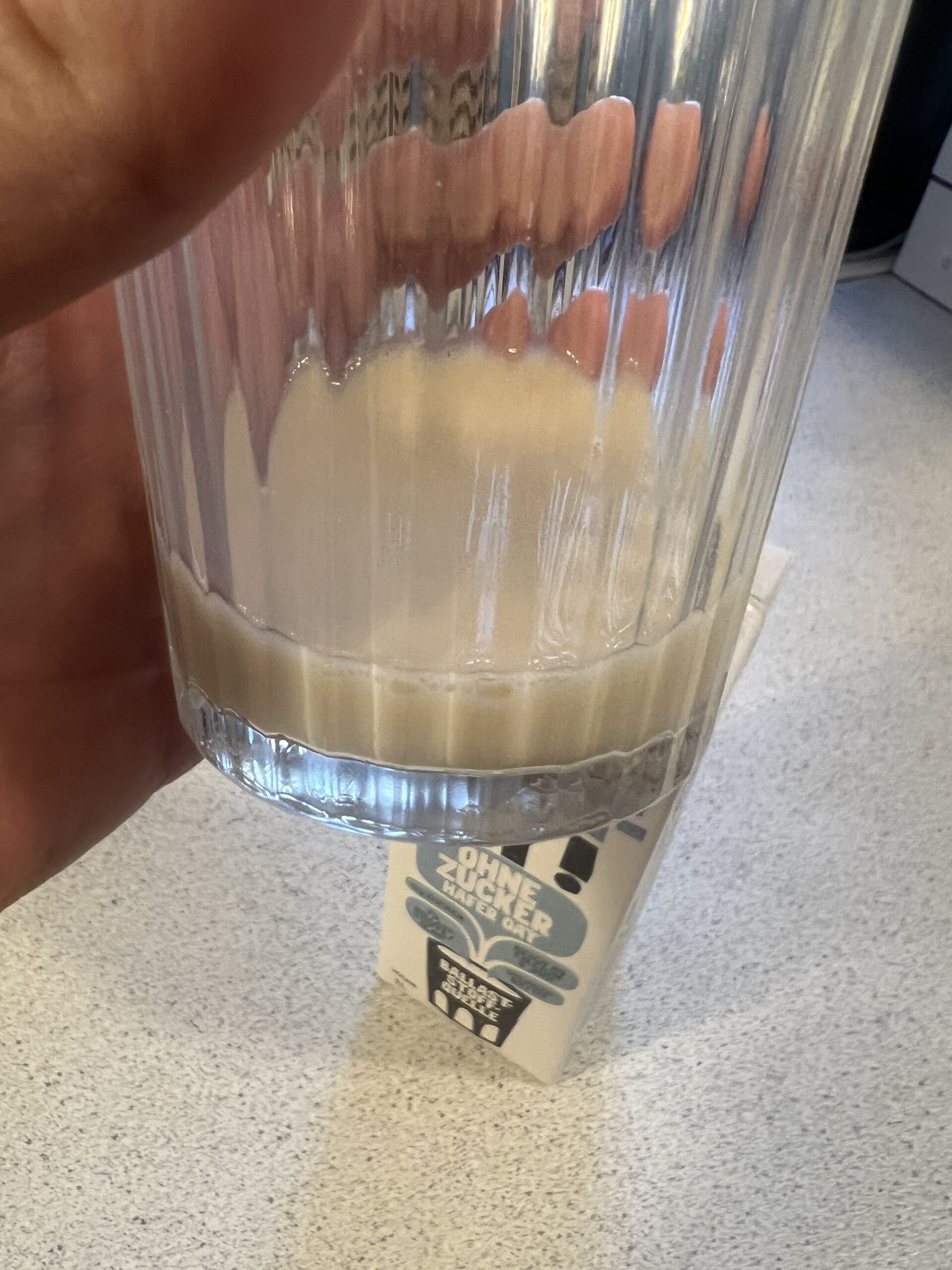
The liquid is not especially thick. I find it smooth and easy to pour, with no noticeable separation in my normal use. I have not experienced bloating, stomach upset or other digestive issues from drinking it. That is an individual observation, not proof that every person will tolerate oats, rapeseed oil or fortified drinks equally well.
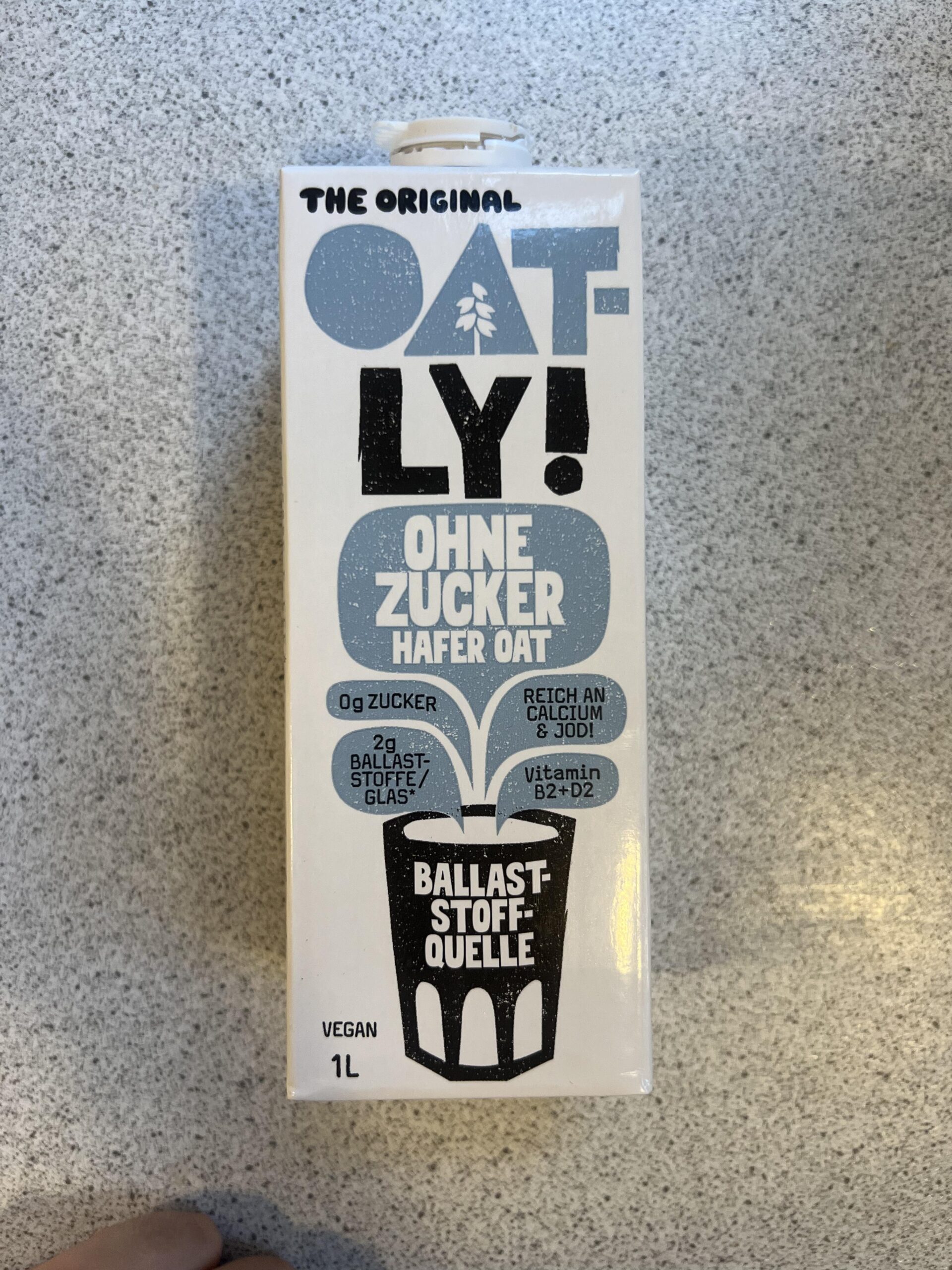
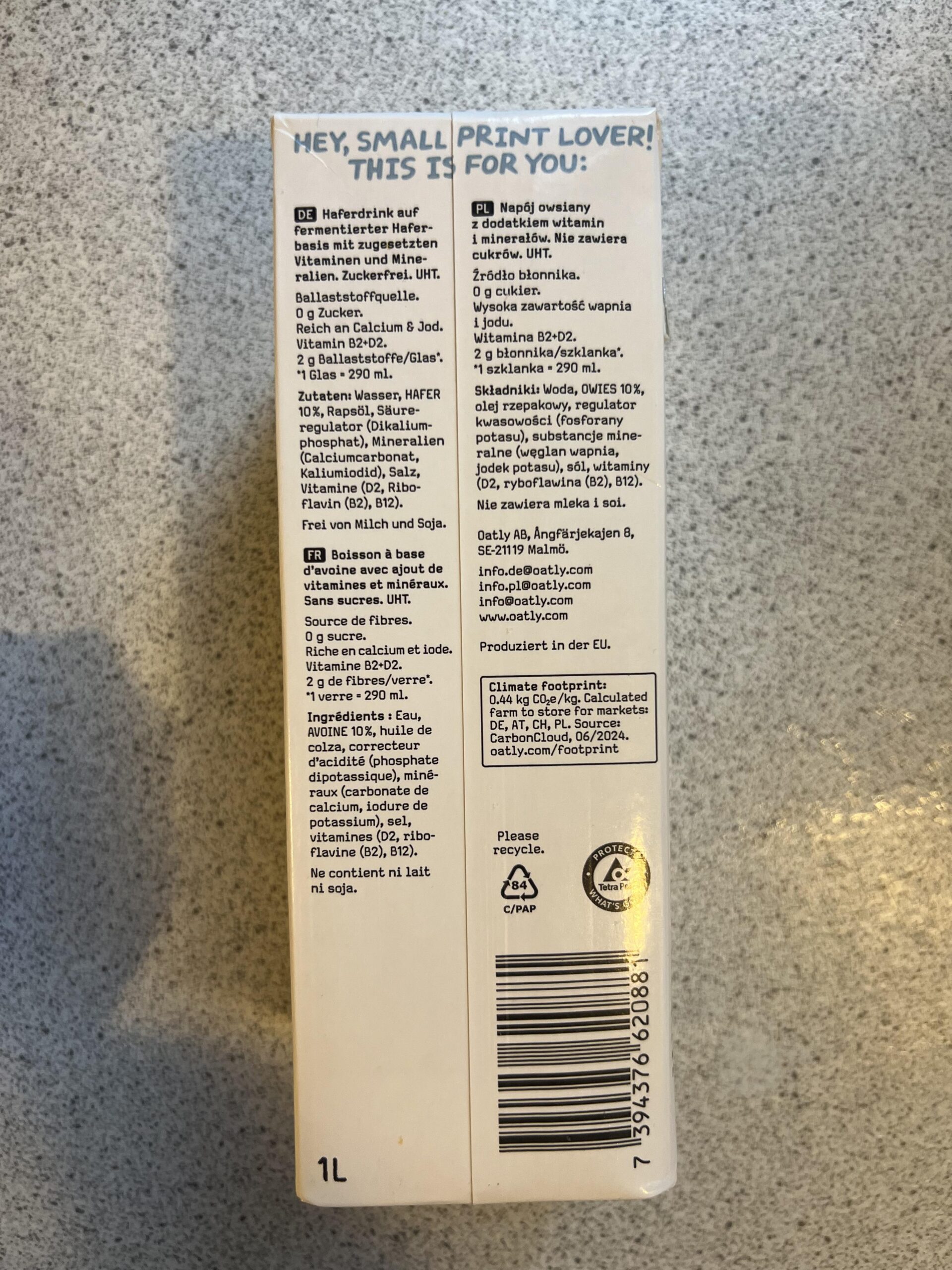
The one-litre carton has been convenient for our kitchen and daily coffee routine. The photos show the actual screw cap, side panels and printed best-before information. The manufacturer says the shelf-stable version can be stored at room temperature before opening; once opened, follow the carton instructions to refrigerate and use it within the stated period. I have not conducted a formal shelf-life test.
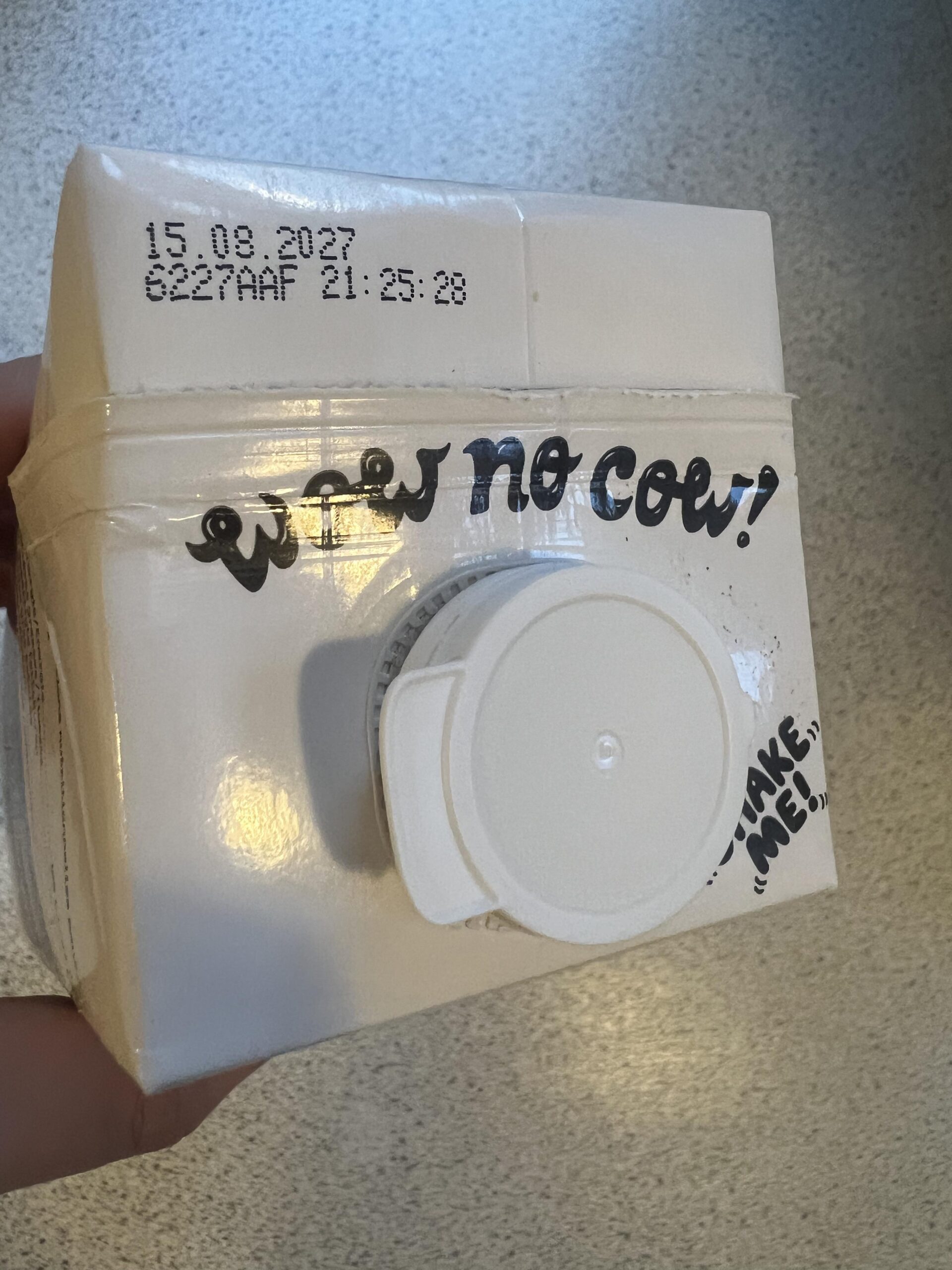
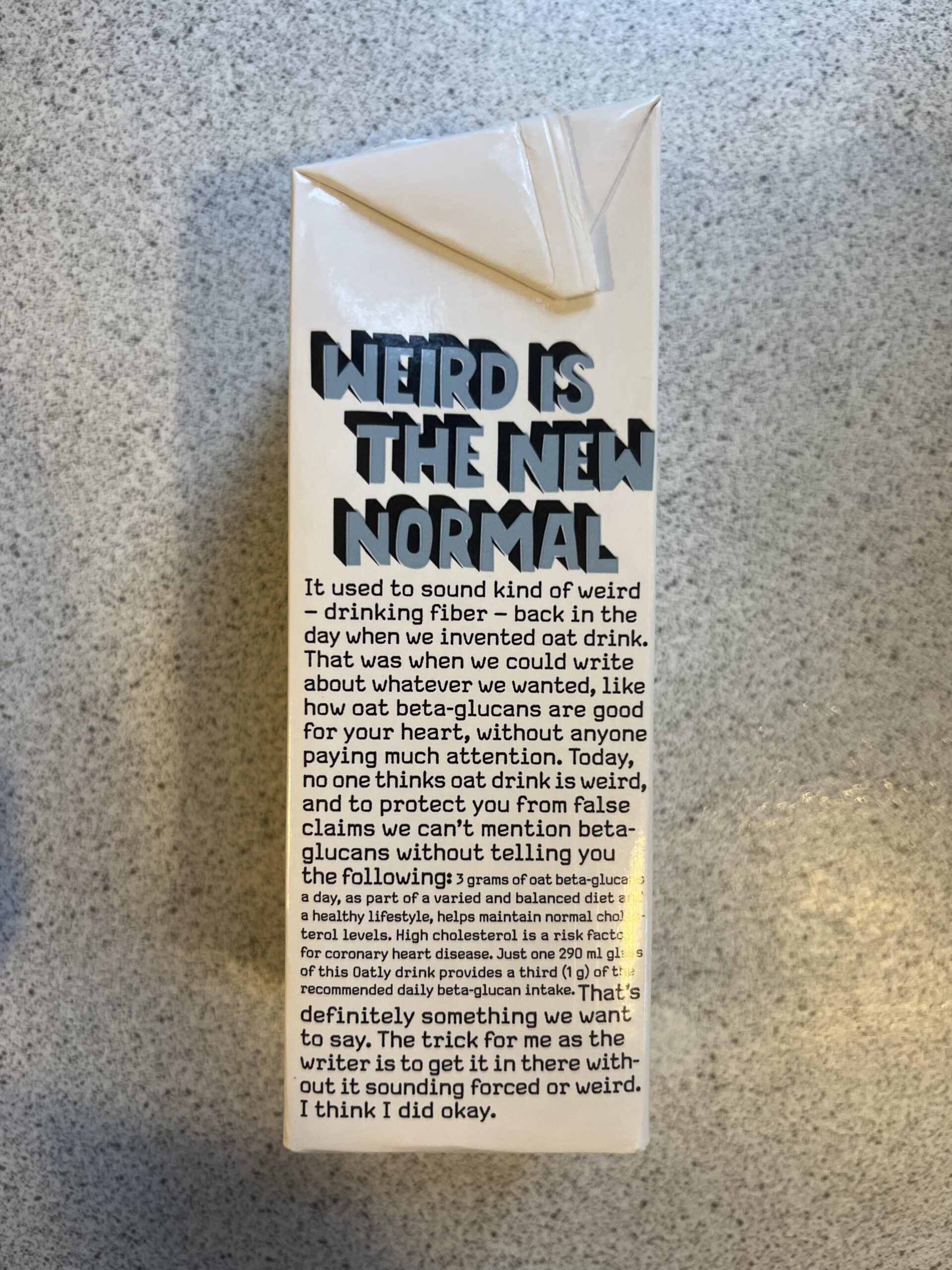
Nutrition: 0 g sugars, but not zero carbohydrates
This is where it is worth reading the back of the carton instead of relying on the product name. Oatly’s official German product page and my photographed nutrition panel both show 0 g sugars per 100 ml, alongside 6.3 g total carbohydrates. That is not a contradiction: the sugar line is one component of the total carbohydrate figure.
| Nutrient | Oatly No Sugars per 100 ml | Why it matters |
|---|---|---|
| Energy | 44 kcal | The carton is not calorie-free |
| Total carbohydrate | 6.3 g | 0 g sugars does not mean 0 g carbohydrates |
| Of which sugars | 0 g | Declared sugars, not an independently measured amount |
| Fat | 1.5 g | Includes rapeseed oil in the ingredient list |
| Protein | 1.0 g | Not a high-protein milk substitute |
| Fibre | 0.7 g | Includes oat fibre |
| Calcium | 120 mg | Fortified; 15% of EU reference intake |
| Vitamin D2 | 1.1 µg | Added vitamin D |
| Vitamin B12 | 0.24 µg | Added vitamin B12 |
| Iodine | 22.5 µg | Added iodine |
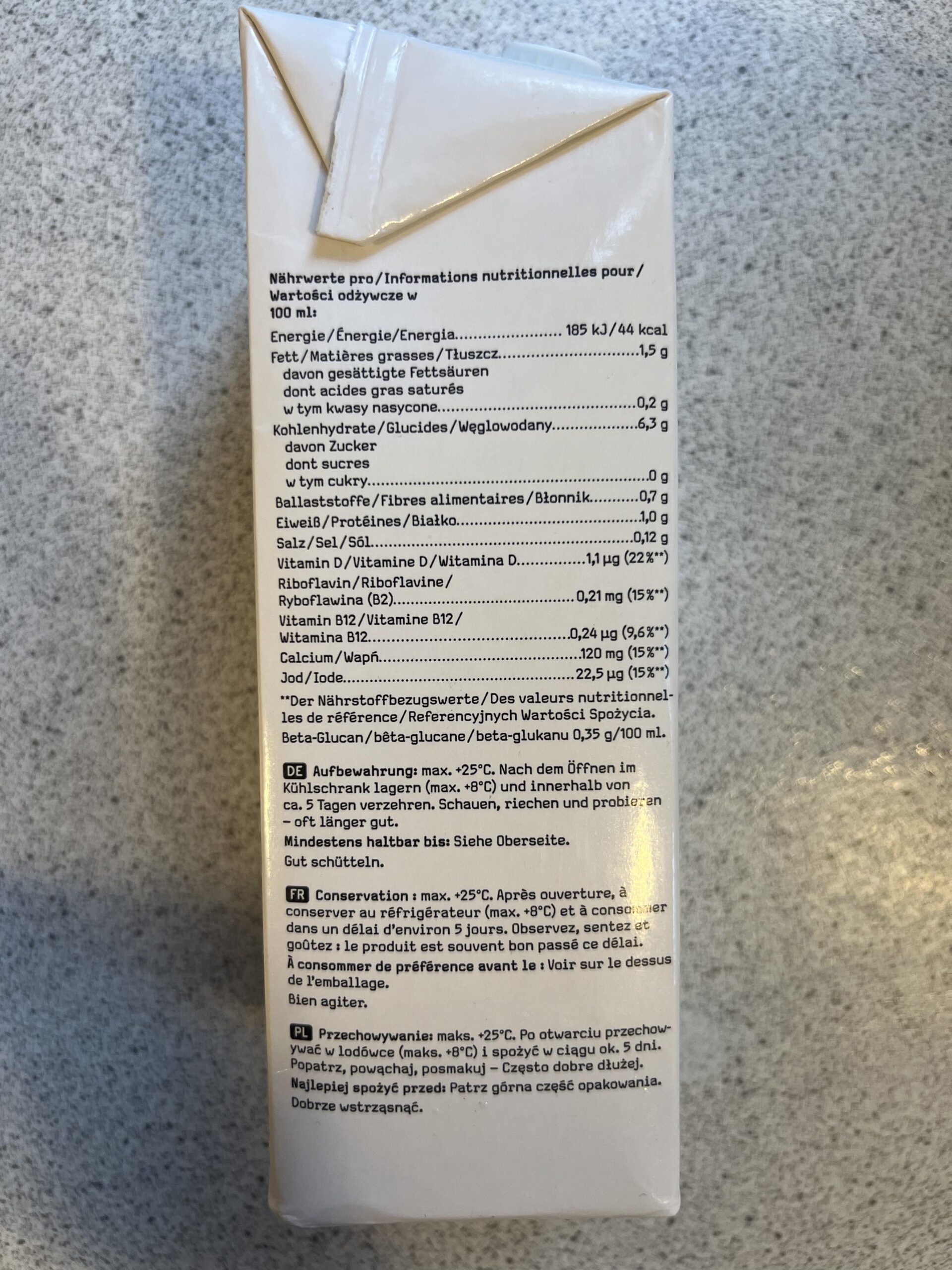
The ingredient list for the photographed shelf-stable version is water, oats (10%), rapeseed oil, dipotassium phosphate, calcium carbonate, potassium iodide, salt, vitamin D2, riboflavin and vitamin B12. The oat drink is vegan and contains oats. It is not a substitute for a high-protein food; the label gives only 1 g protein per 100 ml. Oatly’s German product page confirms the formulation and nutrition figures for this specific version.
I like that it is fortified with calcium, iodine and vitamins, but I would not automatically call it “healthier” than Alnatura simply because the ingredient list is longer or the carton says No Sugars. Fortification can be useful, while some buyers may prefer a shorter ingredient list or organic oats. The best choice depends on the rest of your diet and what you actually want from a milk alternative.
Oatly No Sugars versus Alnatura Organic Oat Drink Unsweetened
This is the comparison that ultimately decides whether I would repurchase Oatly. I have used approximately 30–40 litres of Alnatura Organic Oat Drink Unsweetened before trying Oatly. I prefer Oatly’s taste; to me it has a rounder, more enjoyable oat flavour. But Oatly cost me about twice as much per litre as the Alnatura drink I had been buying. I do not have the exact Alnatura purchase receipts for a precise current price comparison, so the Alnatura price figures below are illustrative rather than verified historical invoices.
| My recorded price | Oatly No Sugars | Alnatura Organic Unsweetened |
|---|---|---|
| Cost per litre | €2.19 (€13.14 / 6L) | About half as much in my experience; no exact Alnatura receipt supplied |
| 6 litres at that rate | €13.14 | Roughly €6.57 if exactly half the price |
| 24 litres at that rate | €52.56 | Roughly €26.28 if exactly half the price |
| Taste to me | My preferred, pleasantly oat-like flavour | Still usable, but not as tasty |
| Sugar statement | 0 g sugars per 100 ml on this exact Oatly label | ‘Unsweetened’ generally means no sugar added, not necessarily 0 g total sugars; check exact Alnatura carton |
| Which would I buy again? | Probably not at €2.19/L | Probably this one for better value |
At a hypothetical price of half Oatly’s, buying 24 litres of Alnatura would save around €26.28. That is not a live store-price claim; it simply shows why a recurring price difference matters. If you drink oat milk straight, the flavour premium might feel worthwhile. For me, when it is mostly a splash in coffee, it is harder to justify.
One nutrition detail also matters: “unsweetened” does not necessarily mean “0 g sugars”. Alnatura’s official Haferdrink Natur product listing describes a drink without added sugar that nevertheless has naturally occurring sugars, listing 5.2 g sugars per 100 ml for that particular formulation. I cannot independently confirm that this is the exact Alnatura carton from my past purchases, so readers should check their own pack rather than treating the figure as a verified analysis of my previous Alnatura stock. Oatly No Sugars, by contrast, is explicitly labelled 0 g sugars.
Likewise, I have not compared these products with a clinical trial, blind tasting or nutrition outcome measurements. I am making a practical household purchasing decision: better Oatly taste versus lower Alnatura cost.
What I would change — and who should buy it
If Oatly No Sugars were closer to the price of Alnatura, I would be much more likely to buy it again. The taste is good, the consistency works in my coffee, and I had no digestive problems. The only other real drawback for my use is that the coffee does not look as pale or creamy as it can with some other milks. That is a relatively small complaint.
- Choose Oatly No Sugars if: You care most about flavour, enjoy a mildly sweet-seeming oat taste, want the particular 0 g sugars label and value the added calcium, iodine and vitamins.
- Choose a cheaper unsweetened oat drink if: You use it mostly in coffee, the difference in taste is not worth paying roughly double, and you have checked that the alternative’s nutrition fits your needs.
- Do not buy based on this review for latte art: I have not tested frothing or steaming; a dedicated barista formulation may suit that task better, but I cannot claim a first-hand comparison.
- Check the exact pack: This review is for the German shelf-stable Oatly No Sugars 1L carton, not a chilled product, regular Oatly or Oatly Barista Edition.
B0BXLBZZDR and shortened link https://link.amazon/B046Yfe7h were provided as possible shopping references, but I have not independently verified the exact live listing or redirect. I therefore link to the original Oatly No Sugars manufacturer product page rather than presenting an unverified Amazon link as the exact product I tested.Frequently asked questions
Does Oatly No Sugars taste sweet?
To me, yes — pleasantly and slightly sweet-seeming, with a nice oat flavour. That is a personal taste impression. The label itself states 0 g sugars per 100 ml, so I am not claiming added or measurable sugar.
Is Oatly No Sugars good in coffee?
Yes, for my daily one or two morning coffees. I like the taste and have not noticed separation. It does not whiten the coffee as much as some other milks, and I have not tried frothing it.
How much did I pay for the six-pack?
€13.14 for 6 × 1 litre on each of my recorded purchases in September and October 2026, or €2.19 per litre. I bought four six-packs in total for €52.56. These are my historical purchase prices, not a guarantee of today’s retailer price.
Is Oatly No Sugars carbohydrate-free?
No. It contains 6.3 g carbohydrates per 100 ml according to the label, despite containing 0 g sugars. Those figures measure different things.
Does it have calcium and vitamin B12?
Yes. The official German label lists 120 mg calcium and 0.24 µg B12 per 100 ml, alongside iodine, riboflavin and vitamin D2.
Does Oatly No Sugars foam well?
I do not know from personal experience because I have not tried frothing or steaming it. My review covers ordinary coffee, occasional tea, and muesli in our household.
Would I choose Oatly or Alnatura next time?
Probably Alnatura Organic Oat Drink Unsweetened because it cost me roughly half as much. I still prefer Oatly’s taste; the deciding factor is value for money in my coffee routine.
Sources and how this review was made
- Oatly Germany: Oat Drink No Sugars 1L — exact product identity, ingredients, nutritional information, shelf-stable variant and recommended uses.
- Alnatura: Haferdrink Natur 1L — reference for an unsweetened, no-added-sugar oat drink that can still contain naturally occurring sugars. I have not verified this SKU against my earlier Alnatura cartons.
- My original September 13, September 19 and October 3, 2026 purchase records, totalling four six-packs, 24 litres and €52.56.
- Seven original product photos taken by me, including the front carton, actual liquid poured into a glass, ingredients, nutrition facts, side panel and cap.
- My first-hand use in morning coffee and occasional tea, my partner’s muesli use, and my prior experience with approximately 30–40 litres of Alnatura Organic Oat Drink Unsweetened.