Soehnle Page Compact 300 Review: My €14.39 Test
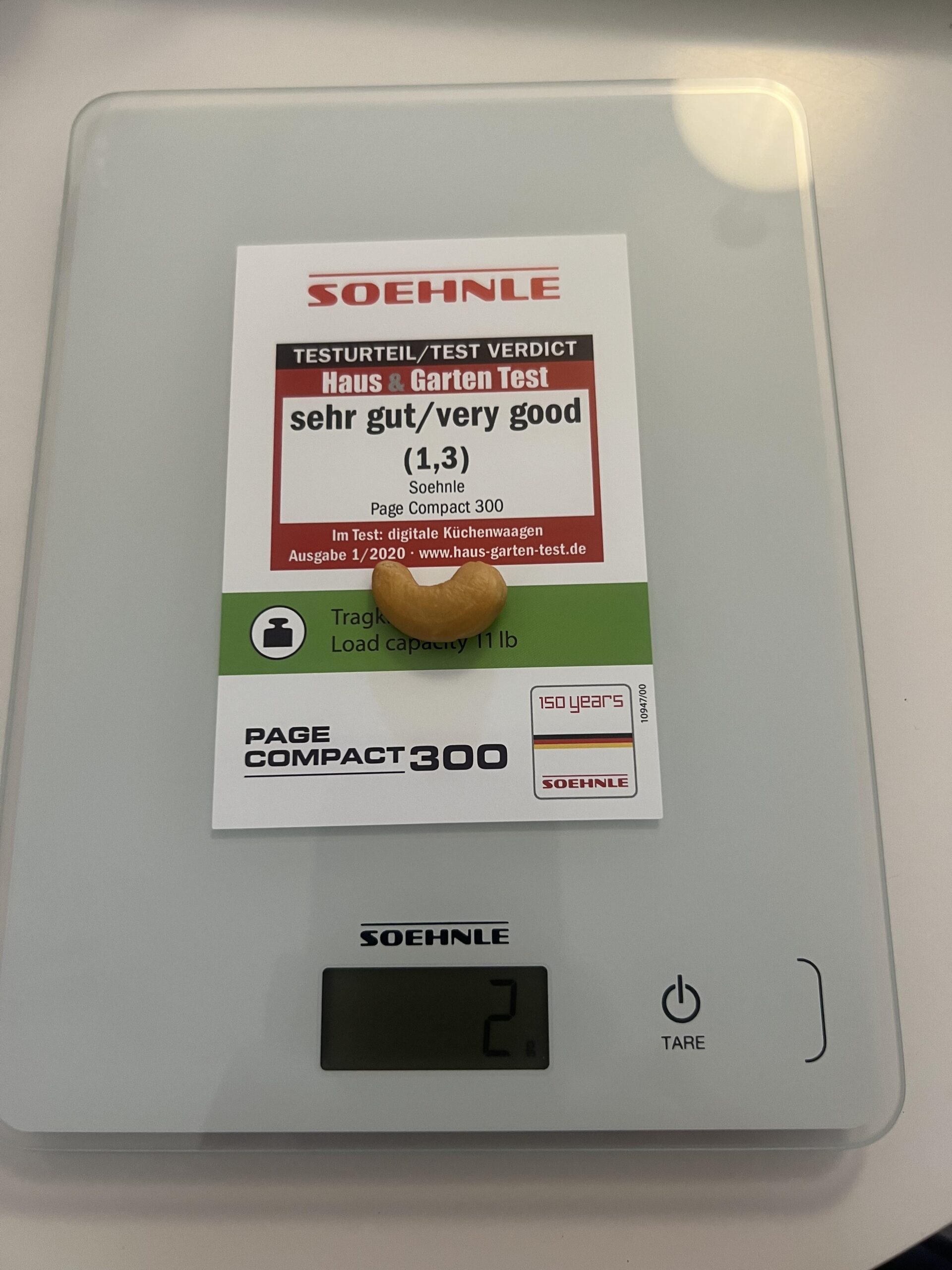
Soehnle Page Compact 300 review — my short first-hand verdict: 3.8/5. I bought the white Soehnle 61501 on 12 October 2026 for €14.39 and mainly used it for a side-by-side kitchen-scale comparison rather than weeks of cooking. The standout finding was that the same cashew repeatedly displayed 2 g; a marker showed 11 g, and a one-litre oat-drink carton showed 1,059 g. Those are photographed display readings, not independent laboratory accuracy measurements.
My overall opinion is mixed: I find the slim design attractive, the display readable, and the touch controls responsive. Yet €14.39 seems a little too expensive for a scale capped at 5 kg, particularly when some less costly scales I have tried advertise 15 kg or 20 kg. The extra price does not give me extra capacity.
Affiliate disclosure: This article includes paid Amazon links. JonTests may earn a commission from qualifying purchases at no extra cost to you. I bought the reviewed product myself; my opinion and editorial score are independent of commissions. See my affiliate disclosure. The owner-provided shortlink is used unchanged; its final redirect and commission tracking have not been independently confirmed, so check the exact 61501 white version at checkout.
Testing scope: These observations come from my initial hands-on comparisons and eight original photographs, not extended use, calibrated test weights, or a verified full-capacity test. My overall score is an editorial judgment based on that limited evidence and stated product specifications.
My tests: same cashew 2 g repeatedly · marker 11 g · oat carton 1,059 g
I paid: €14.39 on 12 October 2026 · historical price
Paid link · compare exact white Page Compact 300 (61501) model and current price before buying
Soehnle Page Compact 300 — my 3.8/5 verdict
Quick verdict: I liked how quickly this slim white scale responded and how clearly its LCD readout and touch controls worked in my brief test. The same cashew repeatedly registered 2 g, which was useful in my comparison with other scales. But the €14.39 price feels high for a 5 kg ceiling when I have tried cheaper alternatives with up to 15 kg of capacity.
Best for: someone who values a compact, clean-looking scale, finds 5 kg plenty, and prefers straightforward touch controls.
Skip if: you want more than 5 kg of weighing headroom, prefer a lower price, dislike fingerprints on glass, or regularly put large bowls over the display.
My perspective: a good scale in my short test, but not the best value among the models I bought.
What I liked
- My same cashew repeatedly displayed 2 g
- Quick, stable readouts in the checks I performed
- Clear LCD and responsive touch controls
- Thin, tidy design that stores easily
- Stable glass surface that wipes down easily
What held it back
- €14.39 felt expensive for a maximum of just 5 kg
- Cheaper scales I own offer higher stated capacity
- The white glass still shows fingerprints and marks
- Large bowls can get in the way of the display
- I have not assessed long-term durability or certified accuracy
Bottom line: 3.8/5. I had a positive experience with the Soehnle’s readability, controls and small-item repeatability, but price and a 5 kg weight limit prevent me from calling it the best buy. The 2 g cashew result is repeatable in my hands-on checks, not a calibration certificate.
What my actual photographs show: three weighing examples
A kitchen scale needs to handle the ingredients and containers you use most. I made three simple checks and photographed the screen each time. The cashew measurement is the most useful because I used the same cashew on several scales, and on this Soehnle the 2 g result was consistent when repeated. That supports short-term repeatability for this one object; it does not establish what the cashew actually weighs.
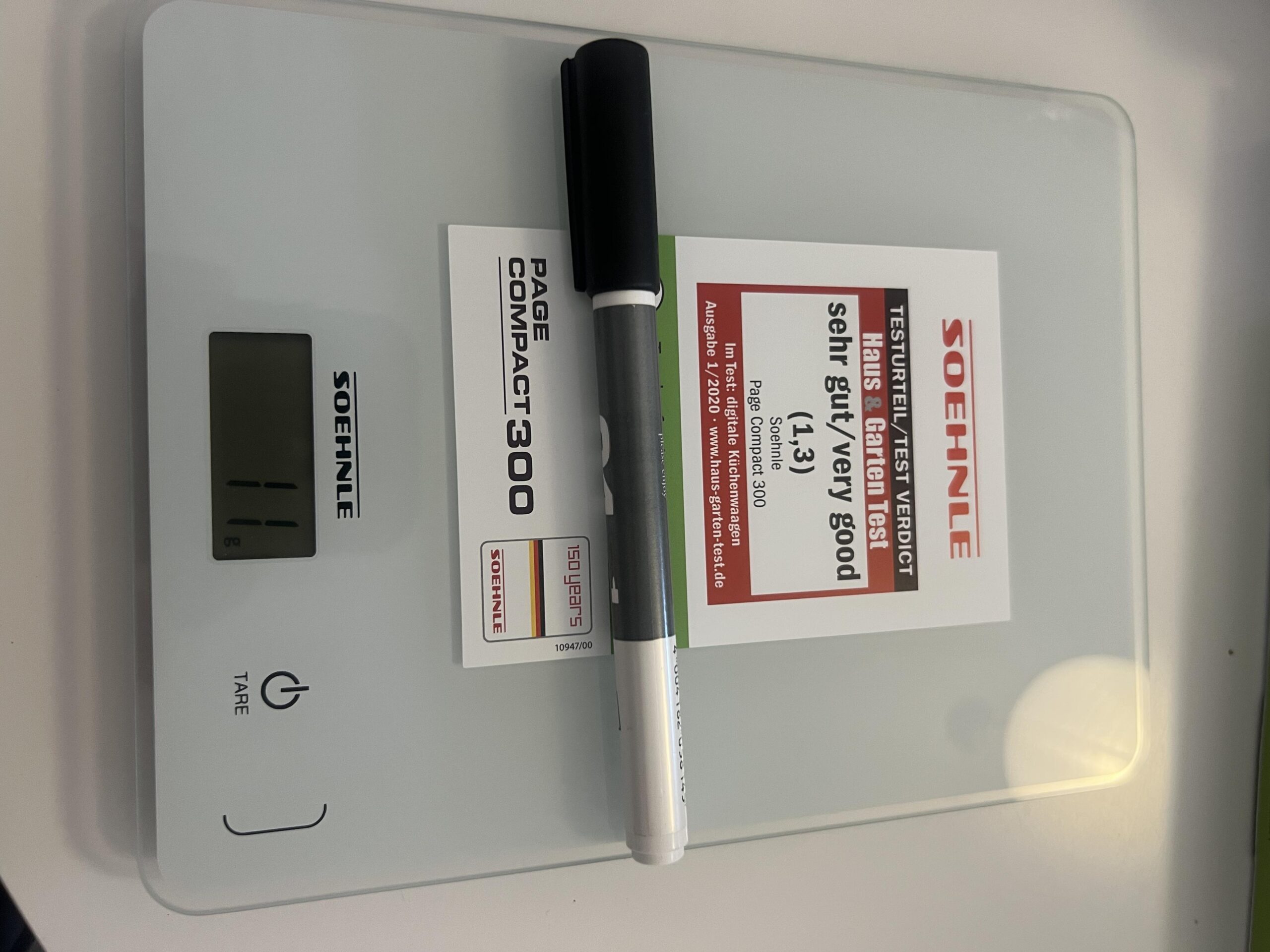
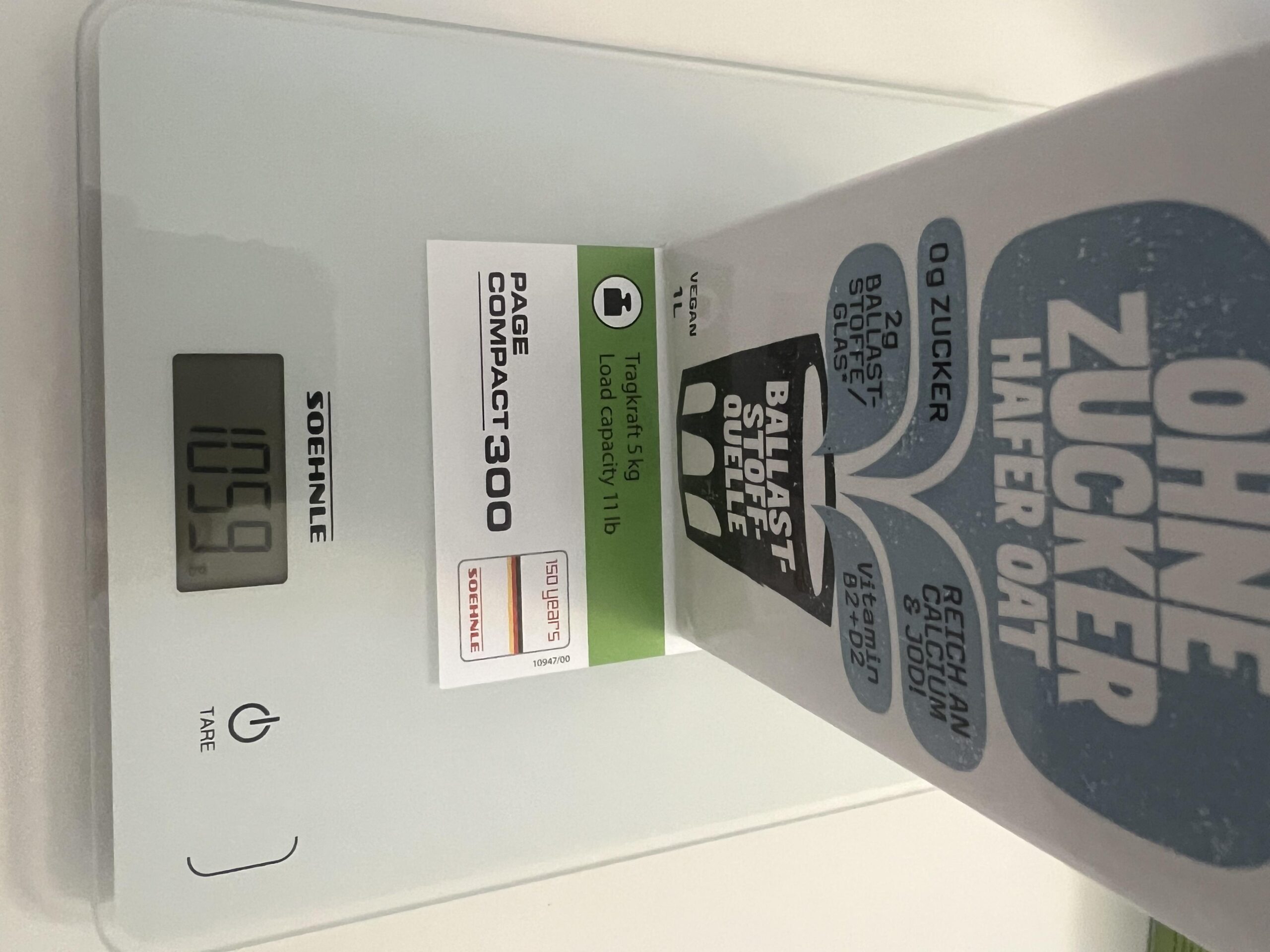
| Item I put on the scale | Displayed weight | What I can reasonably conclude |
|---|---|---|
| Same cashew, weighed repeatedly | 2 g | Detected this very light object and repeated the same displayed reading |
| Marker pen | 11 g | Produced a normal small-object reading |
| 1 L oat-drink carton | 1,059 g | Produced a plausible kilogram-range display reading; no calibrated reference was used |
Important distinction: 1 g display increments mean the screen changes in 1 g steps; they do not mean every object is accurate to within 1 g. I have not weighed certified reference masses or tested the full 5 kg load.
How it feels to use: display, touch buttons and design
My experience with the controls was good. In the short sessions I carried out, the scale responded promptly, readings generally settled quickly, and the LCD was easy for me to read. The touch-sensitive controls also worked without frustration. I cannot say how they would behave after many months of repeated daily use.
The white glass surface looks clean and minimalist, the scale feels stable on a counter, and I find it straightforward to wipe down. It is thin enough to store conveniently. I did, however, notice marks and fingerprints on the glass. And when you use a large mixing bowl, it can get in the way of the display. Those are practical disadvantages even though I like the overall appearance.
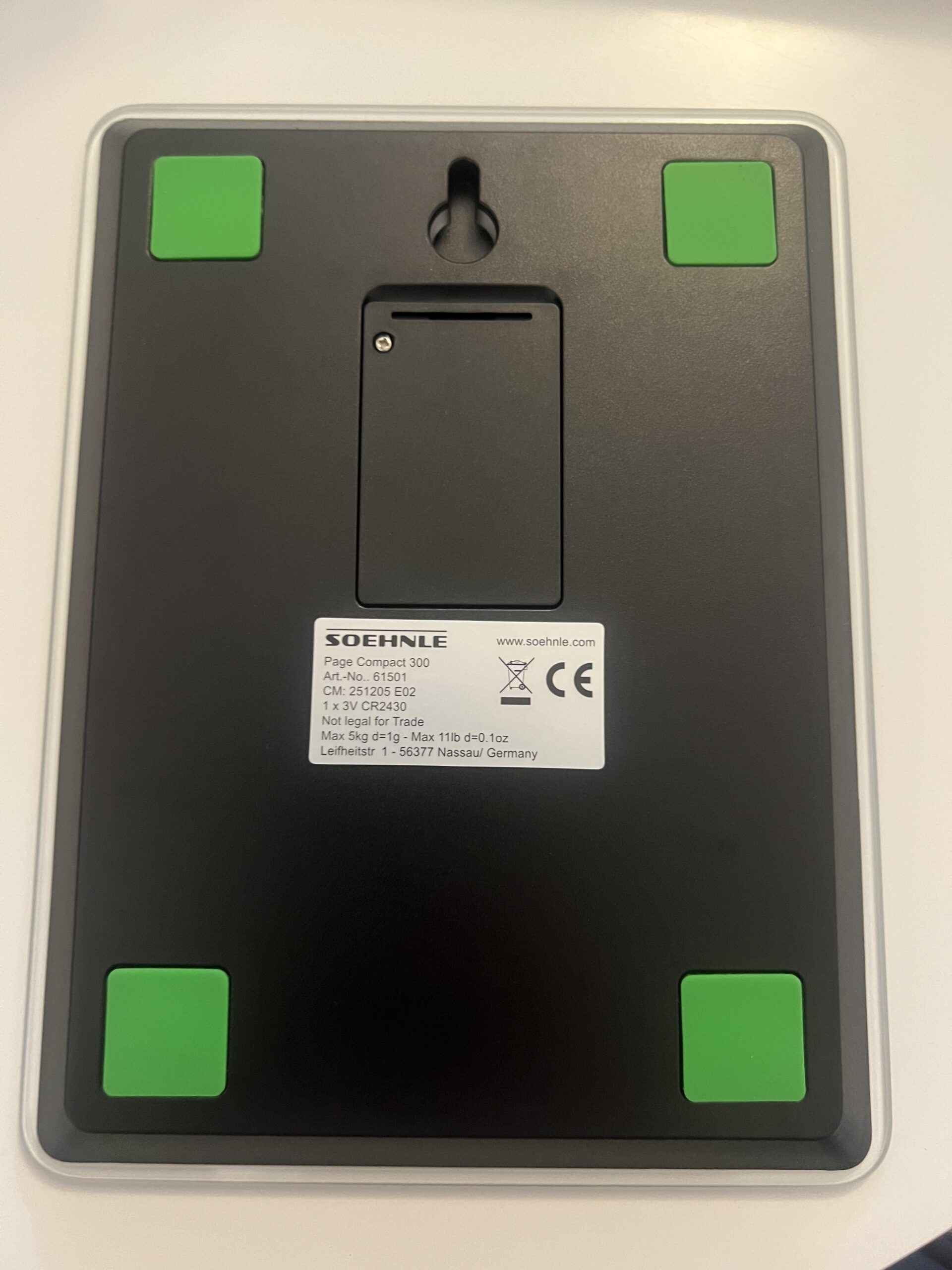
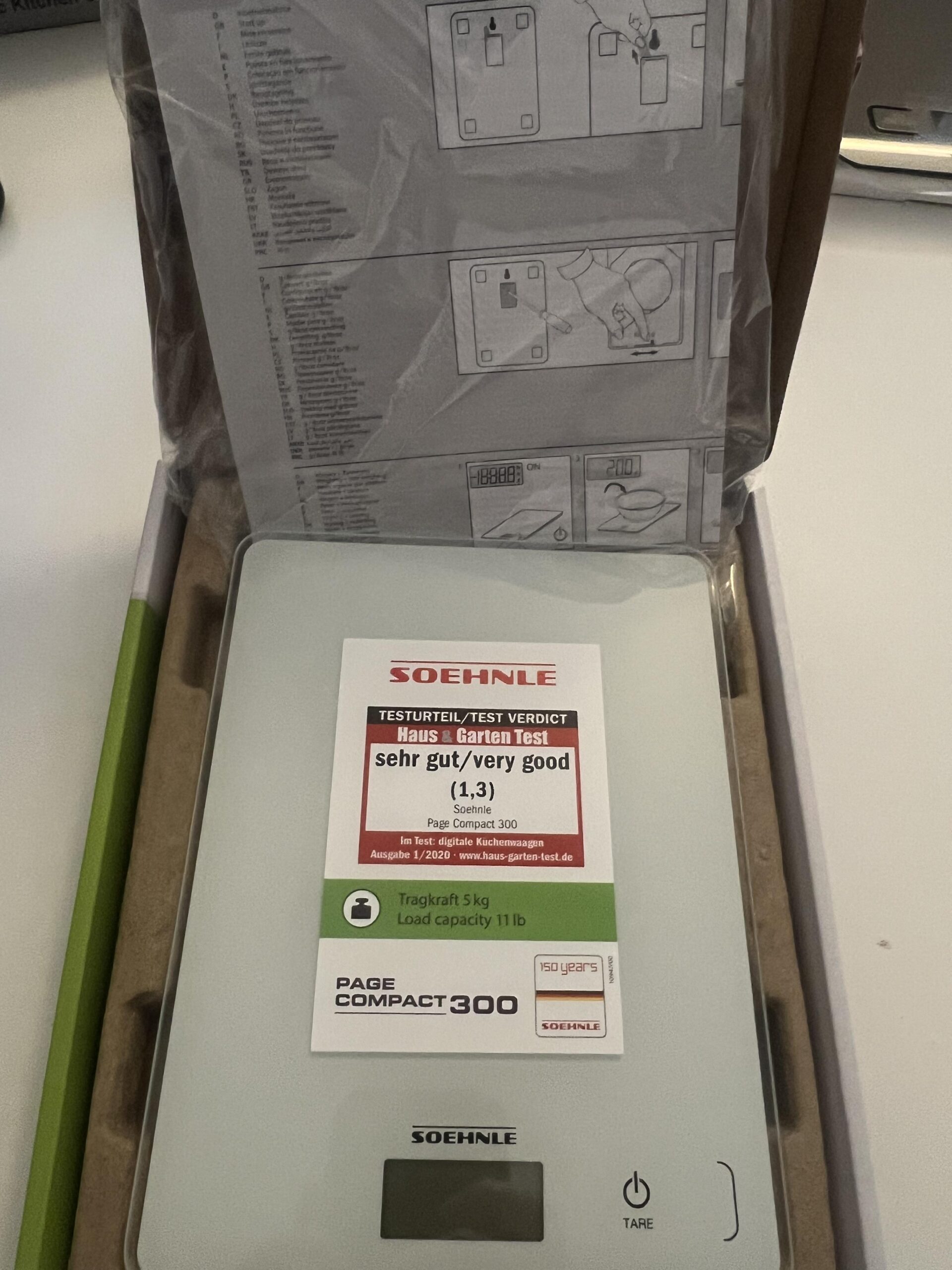
The back has four anti-slip feet and a wall-hanging cutout. The official Soehnle specifications also mention tare, automatic switch-off, gram/ounce-pounds units and an included CR2430 battery. I have not independently measured battery life or tested every unit-switching interaction. Soehnle’s official model 61501 specification.
Specifications: verified product facts versus my experience
| Specification | Soehnle Page Compact 300 (white, 61501) | My hands-on context |
|---|---|---|
| Maximum capacity | 5 kg (manufacturer) | I did not test it at 5 kg |
| Display graduation | 1 g | My same cashew repeatedly showed 2 g |
| Dimensions | 20 × 15 × 1.3 cm | Slim enough to store conveniently |
| Platform | Safety glass / plastic body | Attractive and easy to wipe; marks show |
| Display / controls | LCD; touch-sensitive controls | Both worked well in my short use |
| Functions | Tare, auto-off, selectable units | I did not systematically test every function |
| Battery | 1 × 3 V CR2430; listed as included | Long-term battery endurance not assessed |
| My purchase price | €14.39 on 12 October 2026 | Historical purchase price, not a live store quote |
Compared with my other kitchen scales: where does €14.39 go?
The closest competition is not simply any other Soehnle: it is the group of scales I have personally bought and photographed. At my own purchase prices, this Soehnle costs €7.60 more than my HomeFashion 5 kg, despite sharing the same advertised capacity. I also bought a 15 kg ADE scale for €7.95 — €6.44 less than the Soehnle. Those are historical prices from different purchases, not today’s live prices.
| Scale I reviewed | Stated capacity | What I paid | Same-cashew comparison |
|---|---|---|---|
| This Soehnle Page Compact 300 | 5 kg | €14.39 | 2 g, repeated here |
| HomeFashion 5 kg | 5 kg | €6.79 | 2 g in its review |
| NUTRI FIT EK8840H | 5 kg | €7.99 | 1 g in its review |
| ADE KE2500-1 | 15 kg | €7.95 | 0 g in its test |
| HomeFashion GROSS 20 kg | 20 kg | €9.99 | 0 g in its test |
The different cashew results are not an accuracy ranking: without a certified reference mass, there is no basis to say 1 g, 2 g or 0 g is the correct answer. They show which devices registered this particular very light object under informal test conditions. The Soehnle’s repeatable 2 g reading is a positive, but the HomeFashion 5 kg also showed 2 g for less than half my purchase price.
There is a reasonable case for choosing Soehnle if its specific design, controls or manufacturer support matter more to you than capacity. For me, however, the 5 kg maximum is its biggest value limitation. If you regularly need to weigh substantial dough batches, large bowls or heavy containers, a genuine 15 kg model gives more advertised headroom; capacity alone still doesn’t prove measurement quality.
The award sticker on my unit: what it means
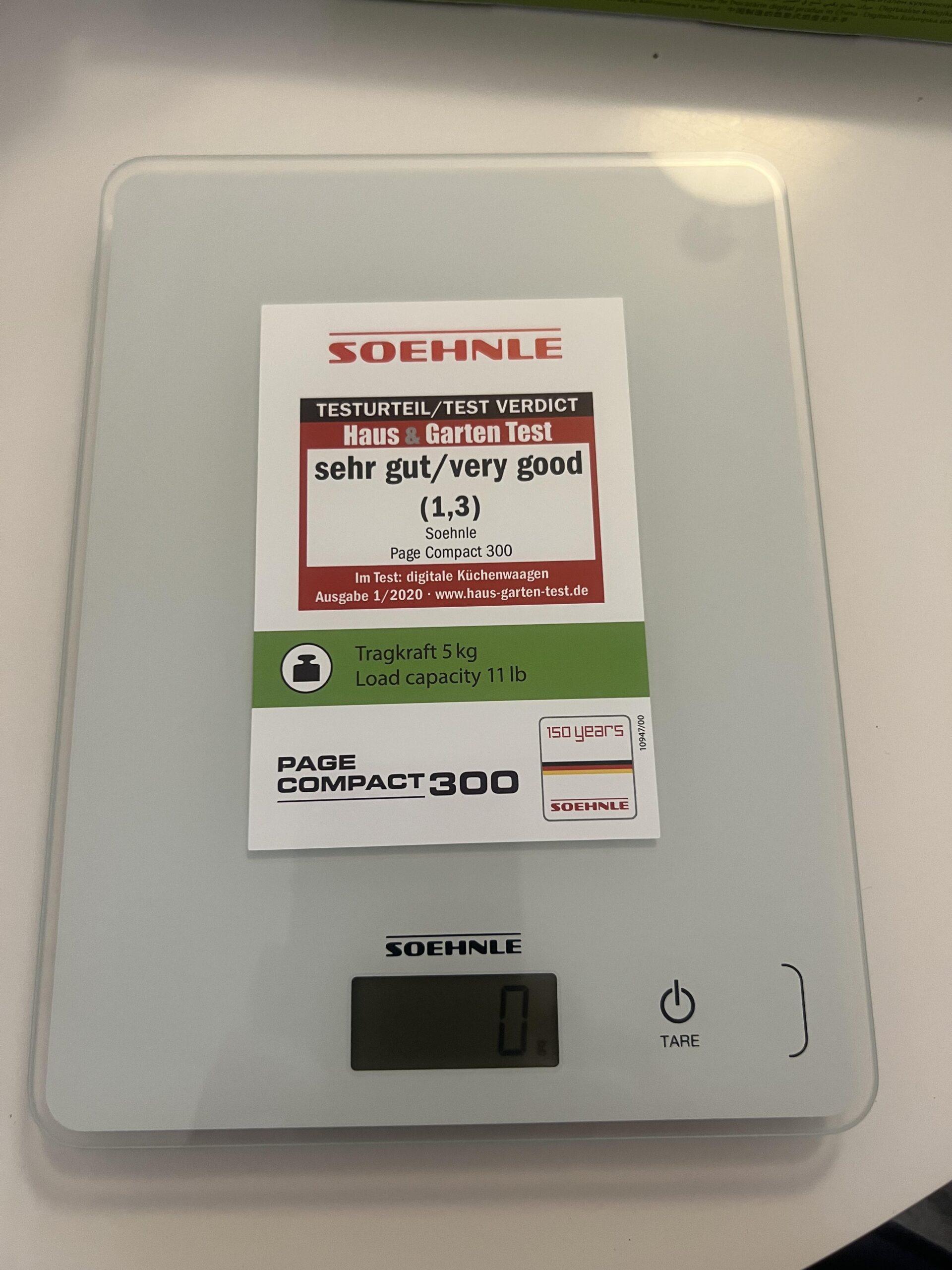
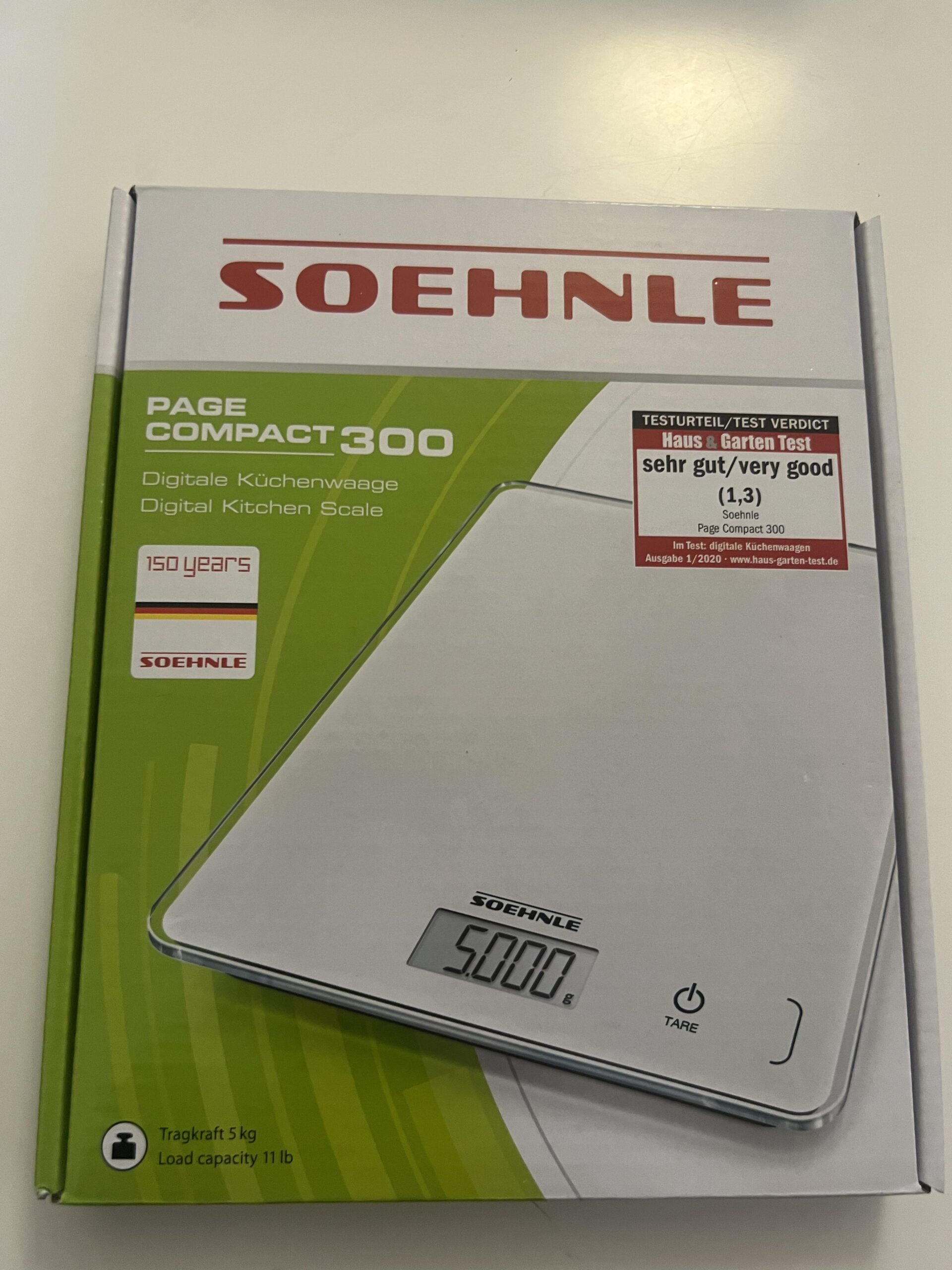
My scale arrived with a sticker referencing Haus & Garten Test, “very good” (1.3), issue 1/2020. That is a historical third-party evaluation shown on the product packaging, not my own 3.8/5 rating and not evidence of how my individual unit performs today. A separate German review aggregator refers to a different 2019 magazine test and notes that unit changing could be cumbersome. I personally found the basic touch controls straightforward, but I did not extensively evaluate switching units.
How I calculated the 3.8/5 editorial rating
This is a short-use, evidence-limited editorial assessment, not an Amazon customer average or a laboratory test. I weighted the attributes that actually mattered in my purchase decision, including the poor value/capacity trade-off. Scores reflect my documented observations plus the verified product specifications; no durability score is included.
| Criterion | Weight | Editorial score | Evidence / interpretation |
|---|---|---|---|
| Small-item response and repeatability | 25% | 4.4/5 | Same cashew repeated 2 g; marker 11 g; other measurements documented |
| Display and controls | 20% | 4.5/5 | Clear display and quick, responsive touch controls in brief use |
| Design, storage and cleaning | 20% | 3.9/5 | Slim, stable and wipe-clean, but fingerprints and bowls obscure display |
| Capacity for my needs | 15% | 2.8/5 | 5 kg maximum falls short of the 15 kg headroom I prefer |
| Value at my purchase price | 20% | 2.8/5 | €14.39 felt costly next to my less expensive 5–20 kg alternatives |
Calculation: (4.4 × 25%) + (4.5 × 20%) + (3.9 × 20%) + (2.8 × 15%) + (2.8 × 20%) = 3.76 → 3.8/5. This opinion could change after more extensive use or a calibrated check. The visible review card and structured data use the same 3.8/5 value.
Who should consider this scale — and who should look elsewhere?
- Consider it: you like a thin, attractive white glass kitchen scale; 5 kg covers your needs; and you value readable LCD digits and easy touch operation.
- Consider a cheaper option: you mainly need ordinary kitchen measurements and do not see a meaningful benefit to paying €14.39 rather than €6.79 for the HomeFashion 5 kg scale I also tried.
- Consider a 15–20 kg alternative: you use larger batches or heavy containers and want more headroom, while understanding that higher capacity does not prove better low-weight accuracy.
- Look for a calibrated precision scale: you regularly weigh very small, sensitive ingredients and need known measurement tolerances rather than informal cashew comparisons.
Frequently asked questions
Is the Soehnle Page Compact 300 accurate to 1 gram?
It has 1 g graduation, according to Soehnle. In my informal use, the same cashew repeatedly registered 2 g; I did not test against certified reference weights, so I cannot substantiate a ±1 g accuracy claim.
Is its 5 kg capacity enough for baking?
It can be enough for many ordinary recipes, but the weight of a mixing bowl also counts toward the total. I personally would prefer a 15 kg model for added flexibility, especially considering what I paid for this 5 kg Soehnle.
Does it come with a battery and tare?
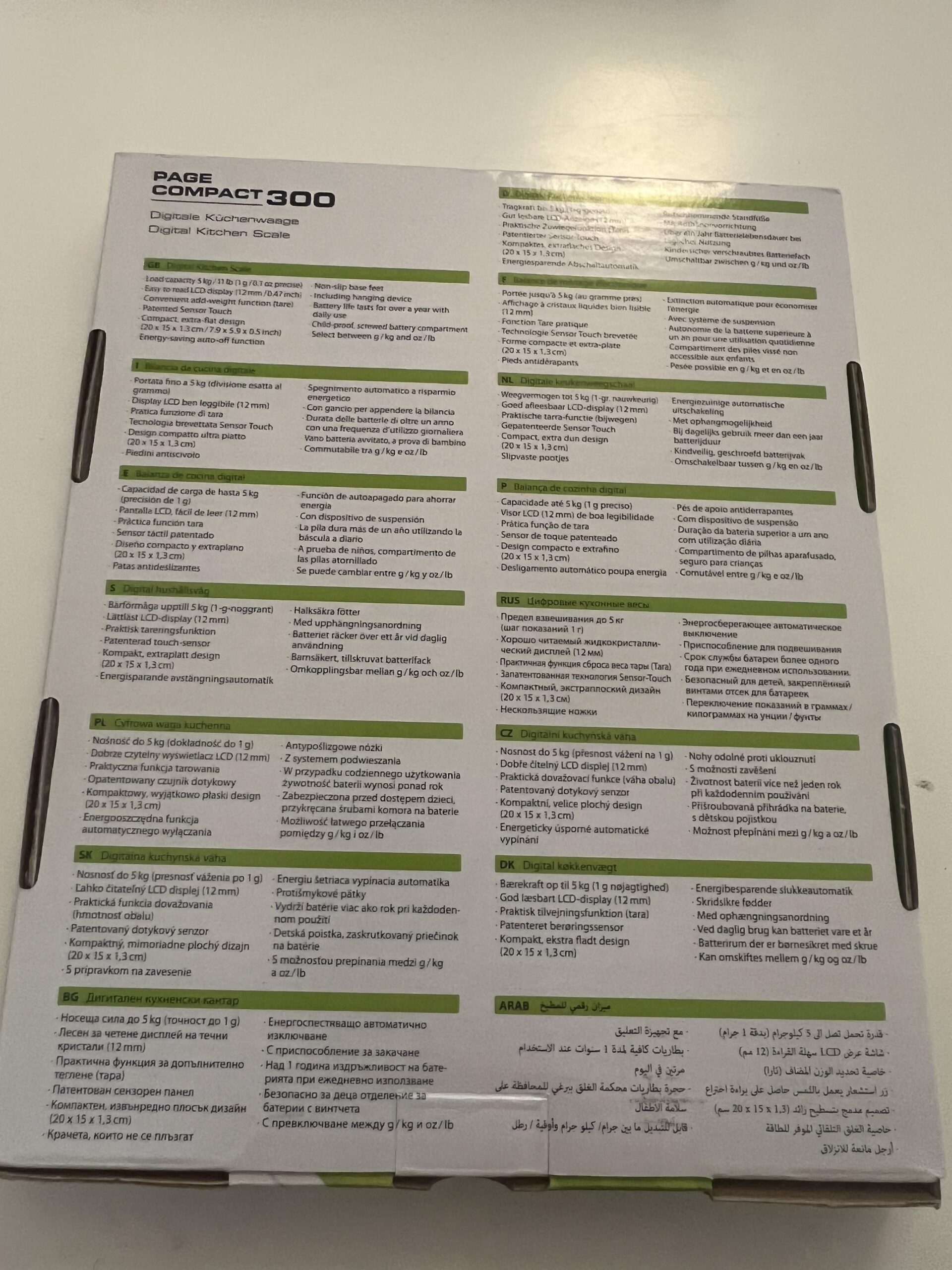
Soehnle lists an included CR2430 3 V battery and a tare function. My original photographs show the packaging and battery-compartment cover; I did not perform a battery endurance test.
Would I recommend it at €14.39?
It’s a perfectly reasonable choice if you particularly like the compact form and straightforward controls. But my own buying priority is more capacity for the money. At the price I paid, I would compare cheaper 5 kg scales and available 15 kg models before choosing it.
Testing limits, sources and disclosure
This article is based on my self-purchased scale, brief hands-on comparisons and eight genuine product/packaging photographs. No laboratory testing, certified reference weights, 5 kg maximum-load challenge, long-term battery analysis or durability study was performed. External specification source: Soehnle / Leifheit model 61501. Third-party testing context: Testberichte overview. The photos and weighed-object observations are my own, not copied from those sources.
Compare my other scales: My Best Kitchen Scales 2026 comparison covers 10 personally bought weighing tools, original photographs, small-item results, capacities, and the scale I ultimately chose to keep.