Soehnle Cooking Star 66220 Review: My 1-Day Spoon Scale Test
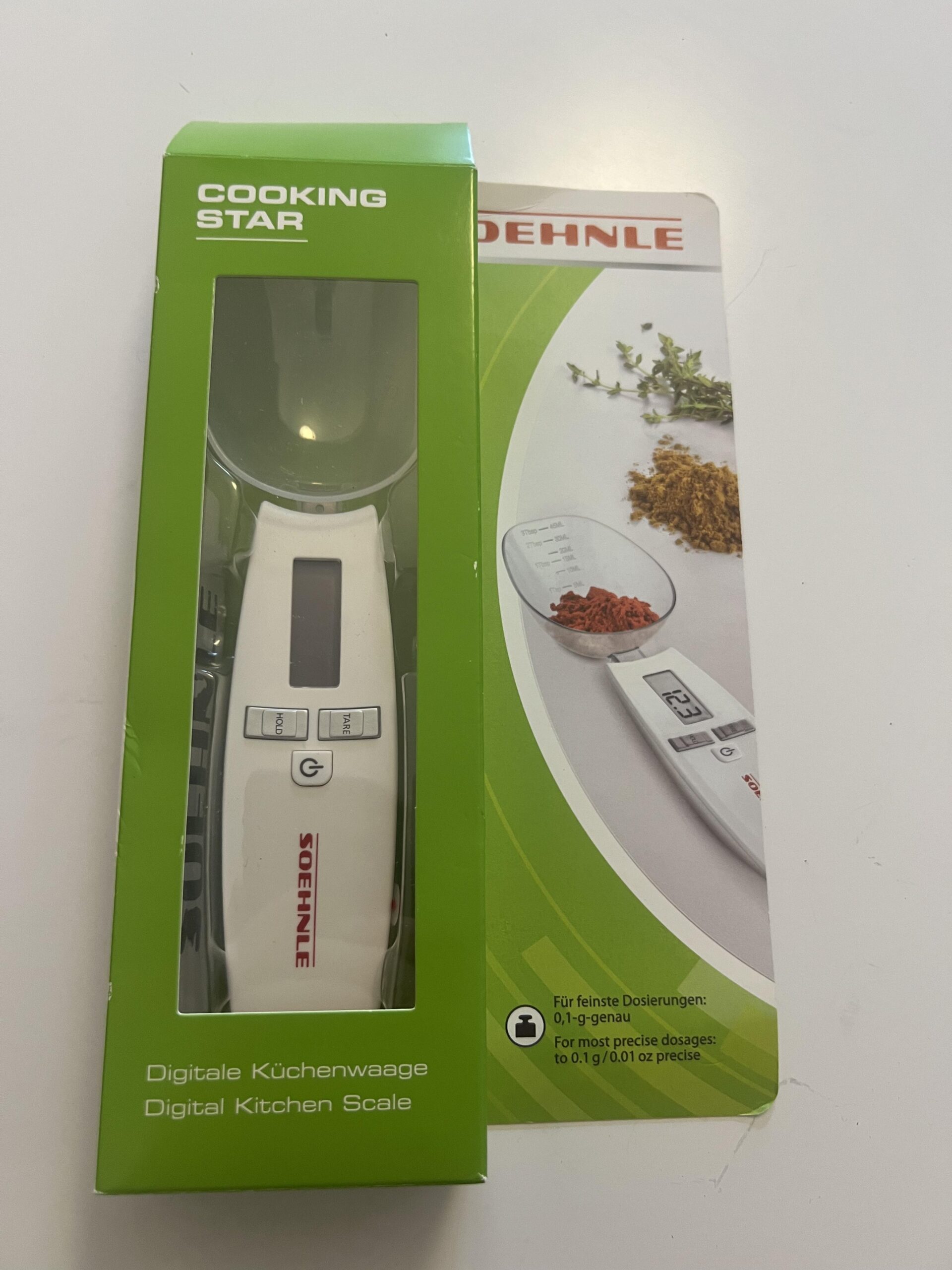
Soehnle Cooking Star 66220 weighing spoon review — my one-day test: 4.1/5. I bought the digital spoon scale on October 3, 2026 for €14.99, without a discount, free sample or compensation. It successfully displayed 1.6 g for a very light cashew nut, whereas my ADE KE2500-1 kitchen scale had failed to register a small cashew after being zeroed. The result was stable in my repeated checks.
My conclusion is mixed. The Cooking Star handles a specialist low-weight task well, has an easy-to-read display and useful HOLD function, and its detachable scoop is convenient. However, the plastic feels a little cheap, it cannot replace a normal kitchen scale, and I would not buy it again for my own cooking: another kitchen scale I own already handles small amounts well enough.
Affiliate disclosure: JonTests may earn a commission from qualifying purchases made through the paid Amazon links below at no extra cost to you. My test was self-funded and the score is an editorial opinion based on one day of use. Full disclosure. Amazon shortlink destination and tracking are not independently verified; select exact model 66220 when ordering.
My test: 1 day · 1.6 g cashew · repeatability checked
I paid: €14.99, October 3, 2026
Paid link · exact 66220 model and tracking not independently verified
Soehnle Cooking Star 66220: 4.1/5
What I liked: It detected a very light cashew, produced stable repeat readings, and had a good HOLD function, readable LCD and easy-to-remove scoop.
What I did not like: Cheap-feeling plastic, a 500 g limit, minimal scoop space, and little value for my own cooking because I already have a sensitive kitchen scale.
Best for: Home cooks who repeatedly weigh very small amounts of herbs, spices or tea.
Would I buy again? Not for myself. It is a worthwhile specialist tool for people who actually need it, not a replacement for a kitchen scale.
Pros
- Registered a single cashew at 1.6 g
- Stable repeat readings in my test
- Readable screen and working HOLD function
- Comfortable level handling
- Detachable, easy-clean scoop with markings
Cons
- Plastic feels cheap
- Only 500 g rated capacity
- No replacement for ordinary full-size scale
- I do not personally need it
- Long-term durability not tested
4.1/5: Good at measuring small amounts, but a niche accessory that I would not repurchase for my own needs.
What I actually tested: a cashew weighing 1.6 g
My most convincing result was a single cashew nut. The Cooking Star displayed 1.6 g. In my earlier ADE KE2500-1 test, that conventional scale could not register a very small cashew after zeroing and showed 0 g. This is an excellent practical illustration of why a separate low-weight tool can be useful.
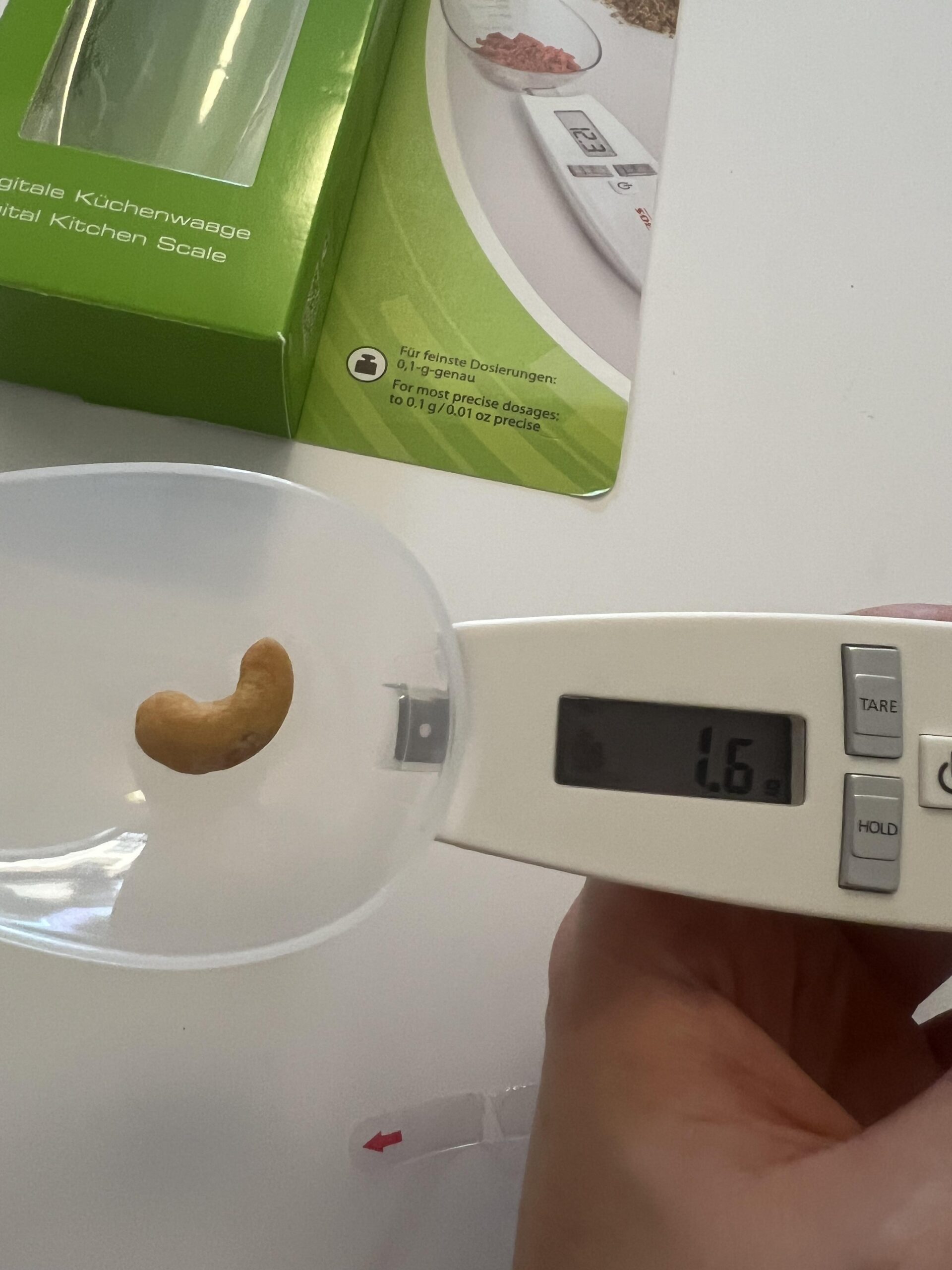
The reading was stable when I repeated a weighing with the same item. However, repeatability is not the same as verified accuracy. I did not use calibrated reference masses or establish that the true weight was precisely 1.6 g. Soehnle advertises 0.1 g display steps; that alone does not demonstrate that every reading is accurate to within ±0.1 g. I would want a proper reference-weight test before making that claim.
My second photo: about 10.7 g with a marker
I also tried the scoop with a marker, and the screen showed roughly 10.7 g. The numbers were easy to see. Once again, this is a record of how the spoon behaved with a real object, not a laboratory validation of the item’s true mass.
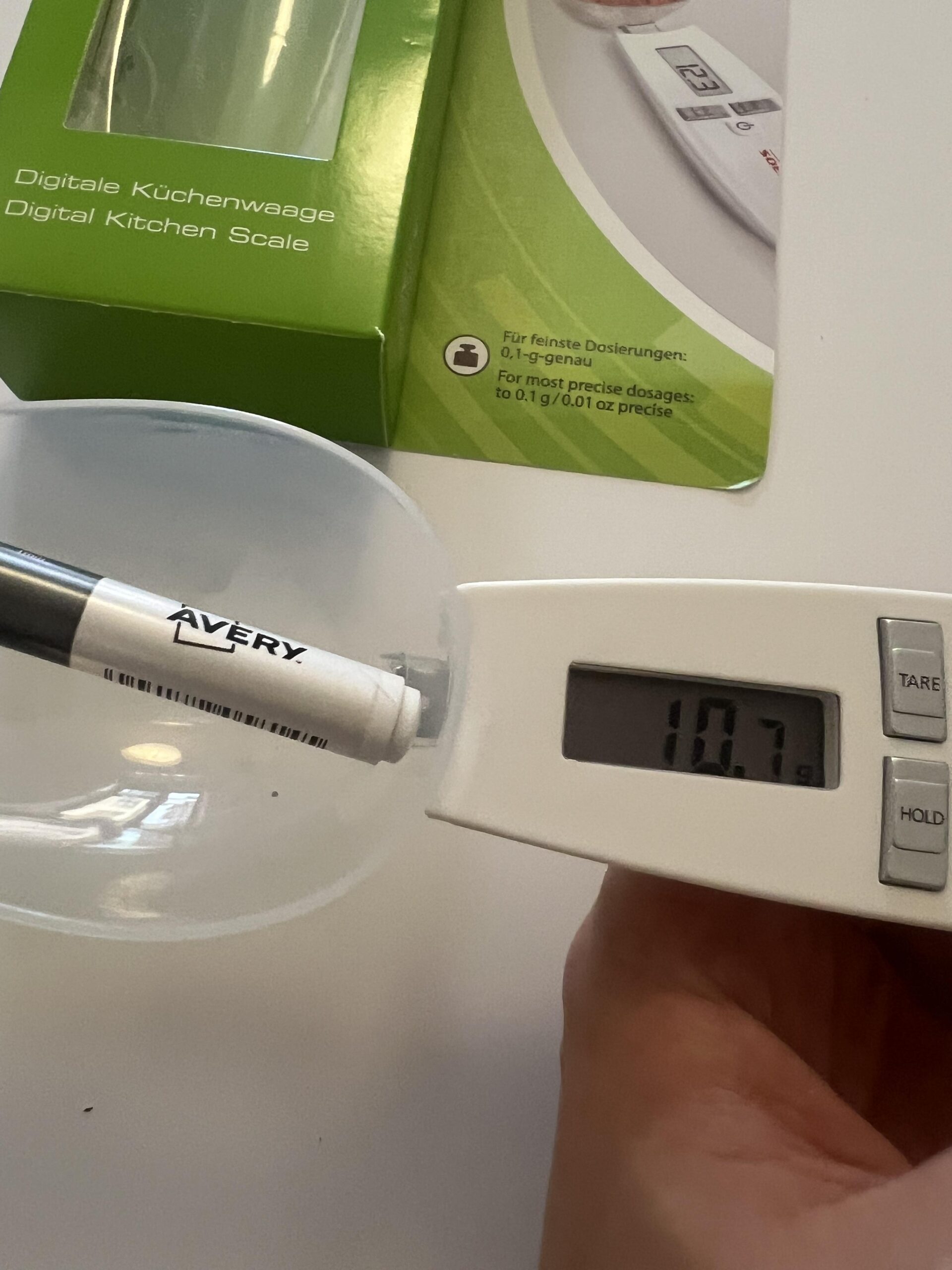
HOLD, display and handling were straightforward
The LCD was easy to read, and HOLD worked well. I found it comfortable to keep the spoon level in my hand during the test, and the controls were simple enough that I did not struggle with the basic operation. This matters because a handheld scale would be irritating if you constantly had to reposition it to read the result. I did not perform timed button-response measurements or tests at different angles.
Removing and cleaning the measuring scoop
The plastic scoop is easy to detach and clean, and mine has tablespoon and milliliter markings. These markings help with approximate volume measurements, which are a different quantity from weight. The manufacturer says the removable scoop is dishwasher-safe, but that does not apply to the battery-powered handle and LCD. I did not test many dishwasher cycles, only the basic detach-and-clean convenience.
Plastic construction and durability concerns
The plastic handle and scoop feel fairly cheap, even though the spoon was comfortable and stable to hold level. I would treat it carefully and avoid bending or dropping it. This is my first impression of the material, not a documented defect: I saw no actual breakdown after one test day, and long-term durability is unknown. Soehnle itself cautions against dropping the unit, applying excessive pressure, or exposing the electronic handle to moisture.
The 500 g maximum makes it an accessory, not a replacement
Soehnle lists a 500 g maximum load, and the scoop only has room for relatively small ingredients. That works for spices, herbs, loose tea or tiny baking additions, but not a normal mixing bowl, a pan or heavy kitchen ingredients. I did not test it with a calibrated 500 g load; that number is the manufacturer’s limit. Most people will still need a regular platform scale for everyday cooking.
Who should buy it — and why I would not
I would not personally spend €14.99 on it again. Another ordinary kitchen scale I own already measures low-gram quantities accurately enough for how I cook, so this is unnecessary extra equipment for me. However, I can see the appeal for enthusiastic home cooks repeatedly measuring expensive spices, herbs, tea and small ingredient portions where a regular kitchen scale struggles. The official product is described as for private rather than professional commercial use, so I would not call it a proven catering-grade instrument.
My Soehnle Cooking Star versus ADE KE2500-1
My Soehnle cost €14.99, shows 0.1 g increments and has a 500 g capacity. My ADE KE2500-1 cost €7.95, shows 1 g increments and is rated for 15 kg. The Soehnle showed 1.6 g for a cashew while the ADE did not register a similar small cashew. Both tests lasted one day, with no laboratory calibration. Their purposes differ: a very-small-ingredient spoon versus an ordinary high-capacity kitchen scale. Read my ADE KE2500-1 review for its full strengths and weaknesses.
Manufacturer specifications: what is verified versus advertised
Soehnle’s official 66220 page specifies a 500 g capacity, 0.1 g increments, g/oz/ml/fl oz units, HOLD, tare, automatic switch-off, a removable dishwasher-safe scoop, one CR2032 3 V battery and dimensions of 23 × 6 × 3.5 cm. These are manufacturer statements, not independently calibrated performance results from my trial. Only the scoop is dishwasher-safe — not the battery-powered handle.
Why I rate it 4.1/5
This is an early-use editorial rating, not a certified accuracy result. I weighted the six factors that matter most to a specialist spoon scale: small-item detection 30% at 4.8/5, short-term repeatability 15% at 4.5/5, display and HOLD 15% at 4.5/5, handling and scoop 10% at 4.4/5, perceived construction 10% at 3.2/5, and versatility and value for my cooking 20% at 2.9/5. The weights total 100%; durability over months is deliberately not scored.
Weighted calculation: (4.8 × 0.30) + (4.5 × 0.15) + (4.5 × 0.15) + (4.4 × 0.10) + (3.2 × 0.10) + (2.9 × 0.20) = 4.13 → 4.1/5. This score recognizes that the Soehnle does its niche job well while still being a purchase I personally would not repeat. I have tested it only for one day. See How I Test.
Compare the other scales I bought: See my Best Kitchen Scales 2026 guide for an original-photo comparison of 10 weighing tools, the actual small-item readouts, capacity trade-offs and the model I ultimately kept. This individual review remains the full source for this product’s first-hand evidence.