Vitafit VT707 15kg Kitchen Scale Review: Why I Kept It
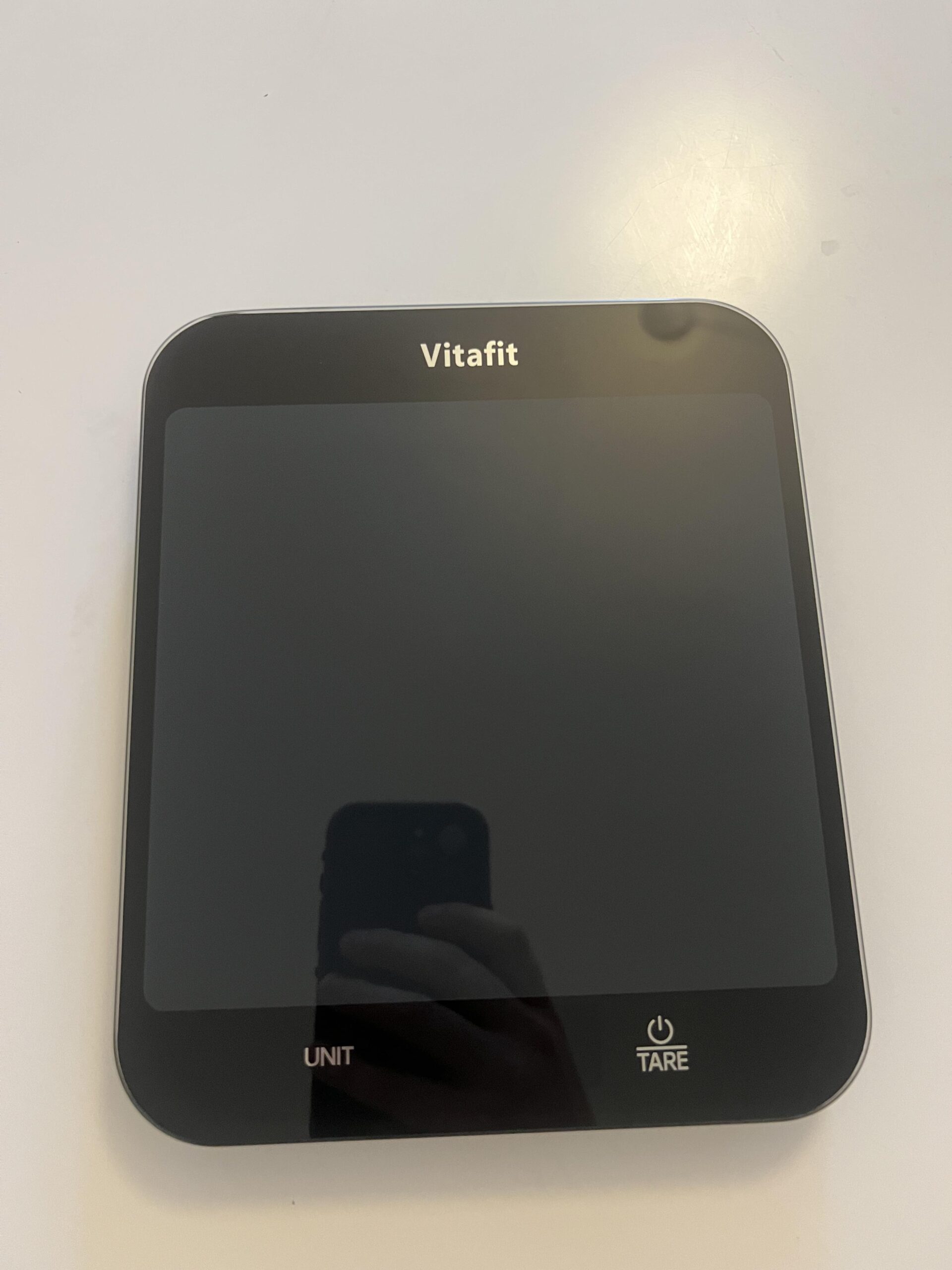
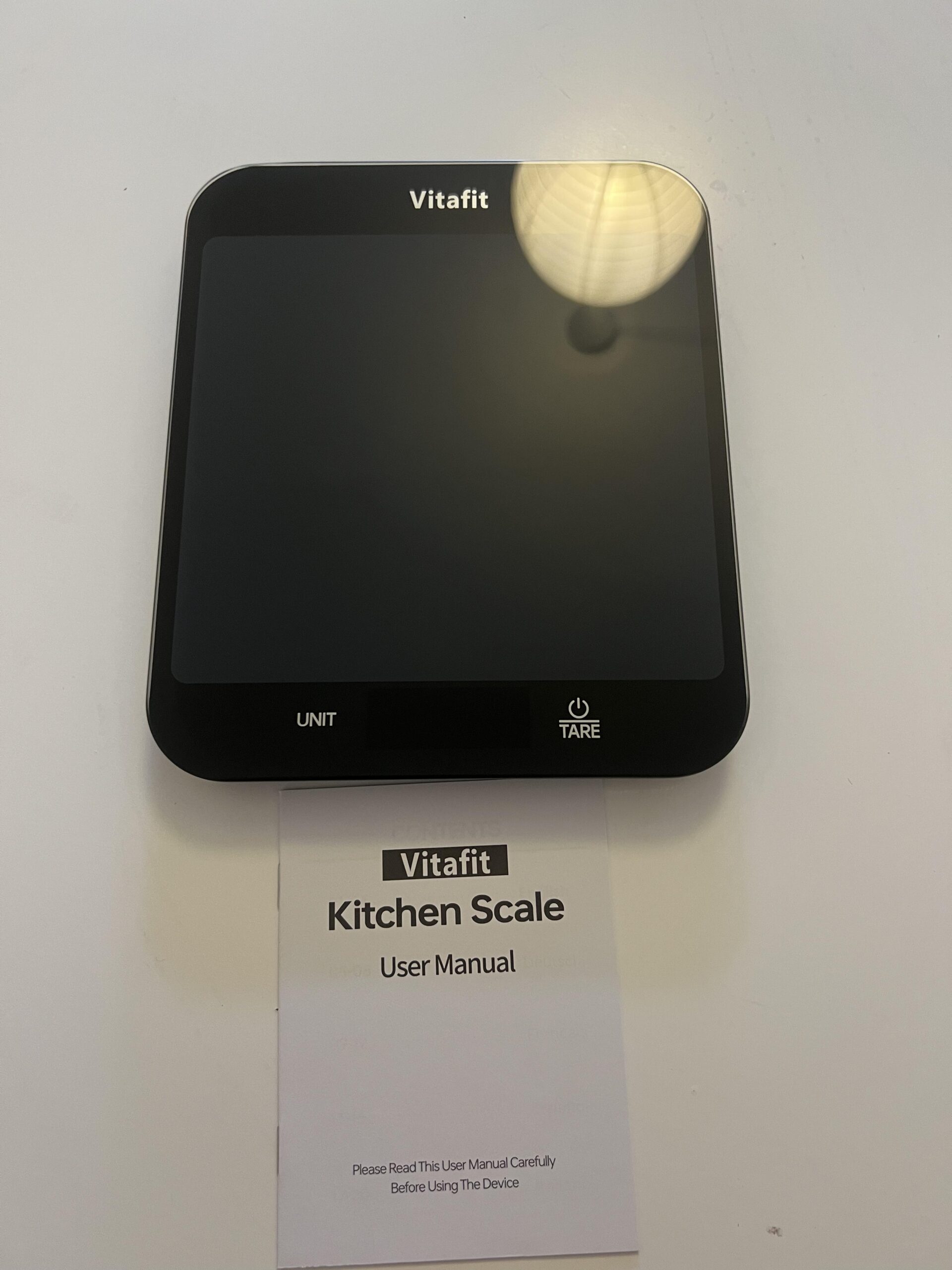
Vitafit VT707 15 kg kitchen scale review — my hands-on verdict: 4.6/5. I bought this black-glass scale on 12 October 2026 for €10.99 and have used it regularly for ordinary ingredients, cooking and baking. After buying and comparing several kitchen scales, this is the one I liked best and decided to keep. It feels sturdy, is simple to use, has a remarkably legible screen even when photographed, and gives me the 15 kg stated capacity I wanted without feeling oversized.
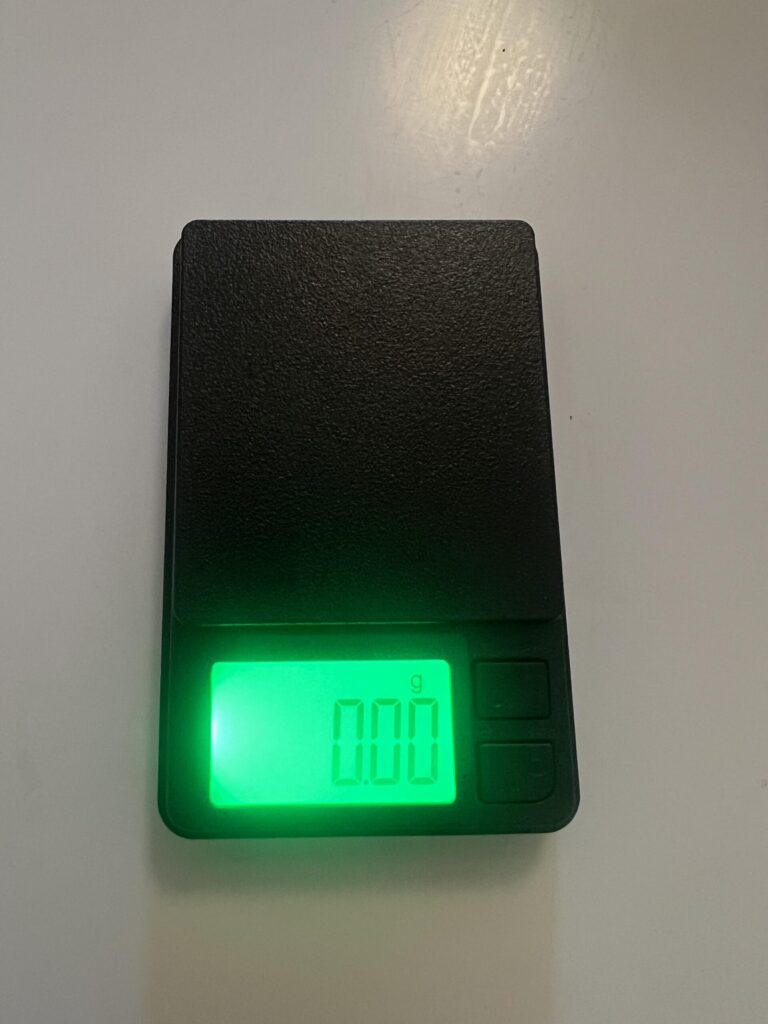
My important caveat is at the very light end. The same cashew repeatedly remained at 0 g on my unit, despite the advertised 1 g display graduation. A marker registered 11 g and a one-litre oat-drink carton registered 1,079 g in my photographs. I find ordinary weighing responsive and consistent, but these objects have not been checked against calibrated reference weights. Because I seldom weigh less than 10 g, the cashew limitation matters much less to me than it would to someone weighing tiny spice or yeast portions.
Affiliate disclosure: This review contains paid Amazon links. As an Amazon Associate, JonTests may earn from qualifying purchases at no extra cost to you. I bought this scale myself, and commissions do not affect my opinion or score. See my affiliate disclosure. The owner-supplied Amazon shortlink is preserved exactly; its technical redirect and commission tracking have not been independently audited.
How I reviewed it: I used my own scale regularly for roughly three weeks as of 3 November 2026, compared my experience with other kitchen scales I purchased, inspected my six original photographs, and checked published VT707 specifications. This was not a calibrated laboratory accuracy test, a full 15 kg load test, or a long-term durability assessment.
My observations: cashew repeatedly 0 g · marker 11 g · carton 1,079 g
I paid: €10.99 on 12 October 2026 · historical price, not today’s quote
Paid link · check the exact VT707 15 kg black model and live price before purchase
Vitafit VT707 15 kg — my 4.6/5 verdict
Why I kept it: This was the best overall fit for me among the kitchen scales I tried. I liked the easy-to-read bright screen, responsive ordinary weighing, quick tare, stable feel, sensible footprint and the useful stated 15 kg headroom.
Best for: everyday home cooking and baking, larger mixing bowls, and anyone who values a highly readable display and generous capacity at a modest price.
Skip if: you regularly weigh one or two grams of yeast, spices, coffee or supplements and need dependable very-low-weight detection; my cashew repeatedly displayed 0 g.
My decision: At the €10.99 I paid, I would keep this one again. Its tiny-load weakness does not interfere with how I personally use a scale.
What I liked
- My favourite scale among the models I bought and compared
- Especially clear LED display, including on camera
- Stable everyday readouts, fast response and easy tare
- Generous advertised 15 kg capacity in a manageable footprint
- Solid-feeling glass platform and excellent value at my purchase price
What to know
- The same small cashew repeatedly registered 0 g
- Not my choice for ingredients below around 10 g
- Glossy surface visibly collects fingerprints
- 15 kg limit and 1 g accuracy were not verified with calibrated weights
Bottom line: 4.6/5. For my normal cooking and baking, the Vitafit is the one I kept: readable, practical, sturdy-feeling and affordable. The main compromise is tiny-item weighing, which my cashew check exposed but which does not matter much to my own recipes.
The one-cashew test: what 0 g does—and does not—prove
My most revealing photo shows one cashew on the platform while the bright LED screen reads 0 g. I repeated that attempt and still did not get a weight. This is a genuine first-hand limitation. The maker’s 1 g graduation describes how the display changes in steps; it does not guarantee every object weighing 1 g will activate or be measured correctly. Product documentation also describes a minimum weighing range that is distinct from the 1 g increment.
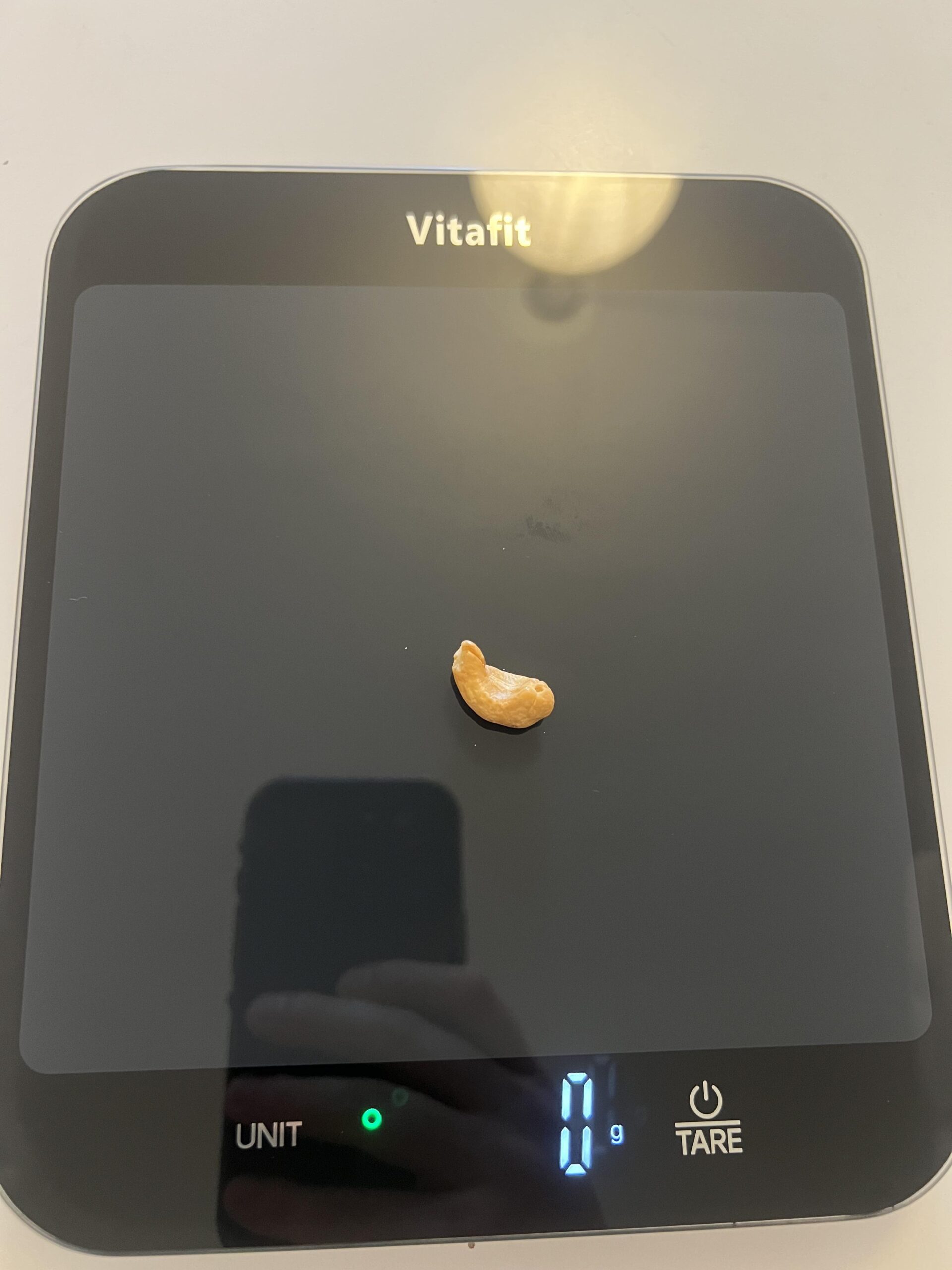
I would not extrapolate one cashew into a precise detection threshold. I did not weigh that nut on a calibrated reference scale, systematically try certified 1–10 g masses, or test all loading methods. I can say my particular cashew repeatedly failed to register. I cannot say every food item below 10 g would be missed. For yeast, tiny spice portions or coffee doses, I would use a dedicated fine scale or perform an appropriate known-weight check.
Everyday weighing and the display: why this is my keeper
Most of my actual use is not measuring tiny quantities. I regularly weigh ordinary ingredients and use the scale for cooking and baking. The readout has been stable, fast and straightforward to work with in those tasks. The tare button has worked promptly for weighing ingredients with a container, and the controls never felt confusing to me.
The display makes a bigger difference than specifications alone suggest. I find the bright digits particularly easy to read at a glance and even when taking photographs. A scale can be technically capable yet frustrating if a large bowl blocks its readout; with this Vitafit I have been happy with visibility during my normal use. I have not tested the screen under every lighting angle or bowl size.
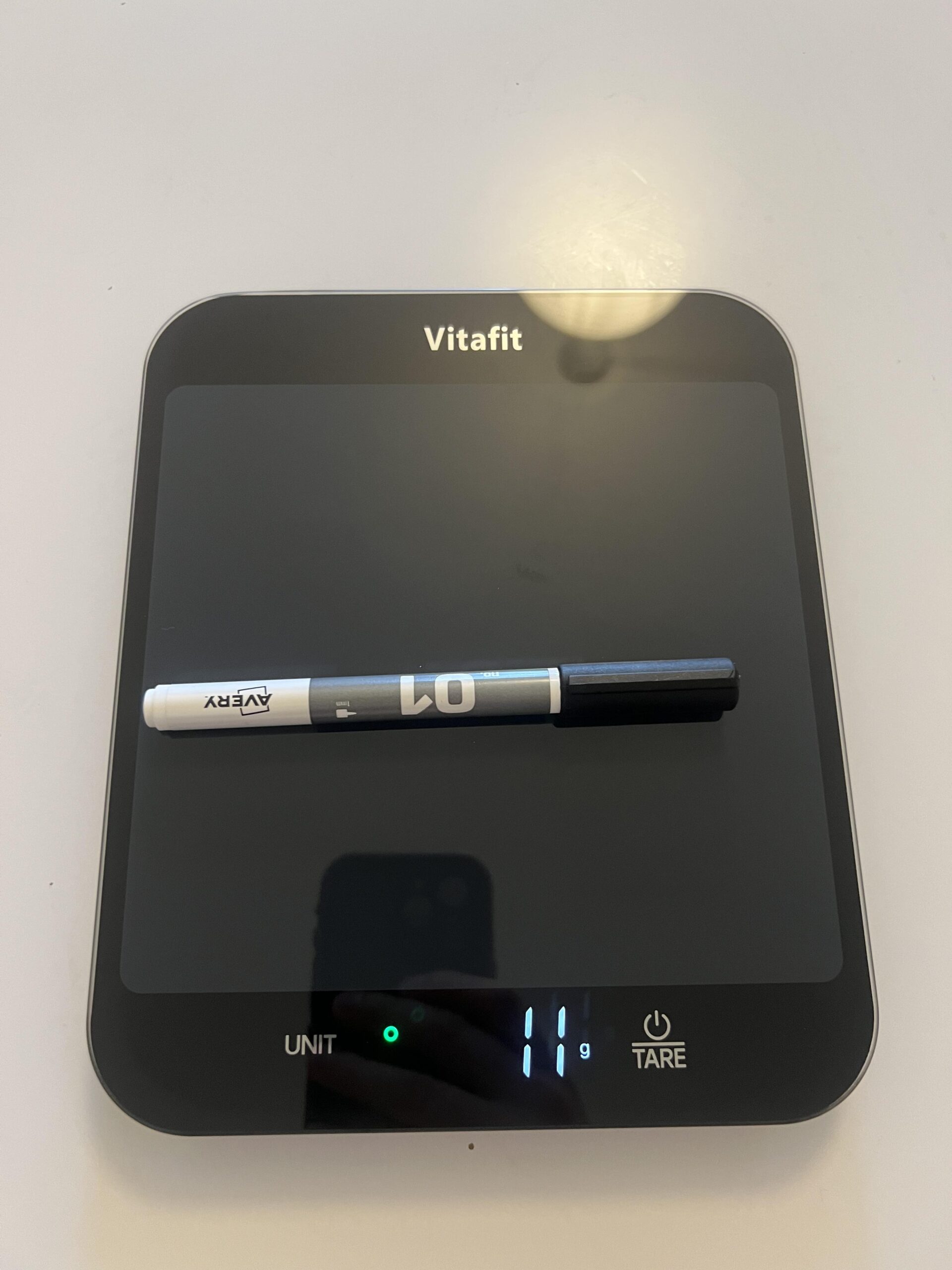
The photograph above shows a marker displaying 11 g. It demonstrates that the scale does display low double-digit weights; it does not establish the marker’s true mass or show that the error is within ±1 g.
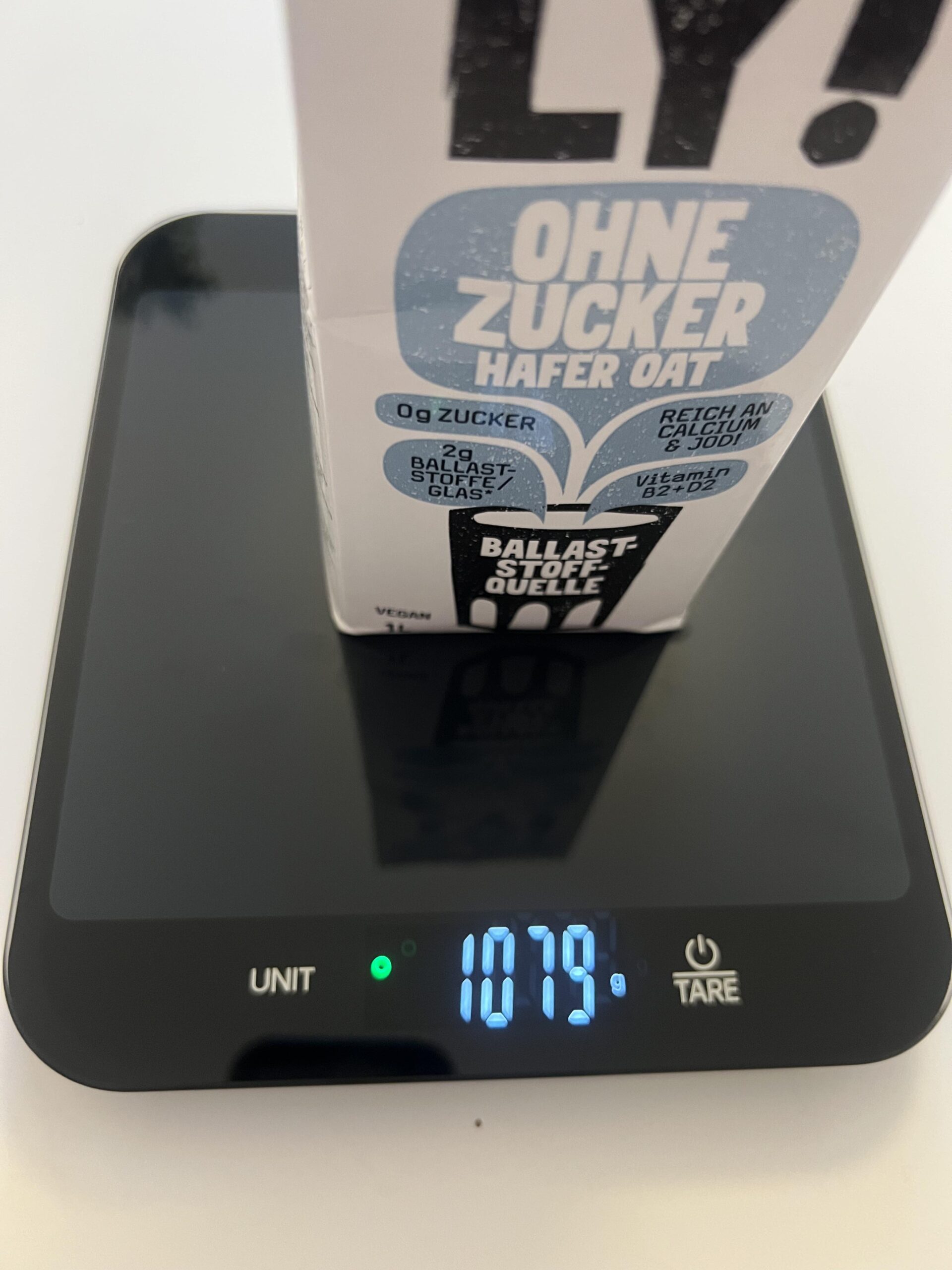
A one-litre oat-drink carton displayed 1,079 g. This is an ordinary-object reading, not evidence the scale measures exactly: carton packaging has weight, liquid density varies, and I did not independently weigh the item. What matters for this review is that my unit responds normally to everyday-sized loads and has been convenient to use repeatedly.
15 kg capacity without a huge scale
The stated 15 kg / 33 lb maximum is one of my main reasons for keeping the Vitafit. I wanted more headroom than a 5 kg model while avoiding an oversized kitchen appliance. Its listed footprint is 215 × 180 mm, with approximately 22 mm height. A mixing bowl and its ingredients both count toward the load limit; the extra capacity can therefore be useful for heavier batches. The 15 kg capacity comes from the product specification—I did not personally test it with a 15 kg reference load.
I find the platform spacious enough for my typical cooking and baking yet easy to store. The black tempered-glass surface feels reassuringly sturdy during handling. That is my short-term impression, not a drop test or a long-term durability claim.
The trade-off: fingerprints on glossy glass
My main physical-design complaint is simple: fingerprints show on the glossy surface. They are easy to notice after handling the scale. I still prefer its finish and overall solidity, and ordinary wipe-down care is straightforward, but someone who wants their kitchen scale to look spotless all day may dislike this. The user manual recommends a mild damp-cloth clean and advises against soaking the electronics.
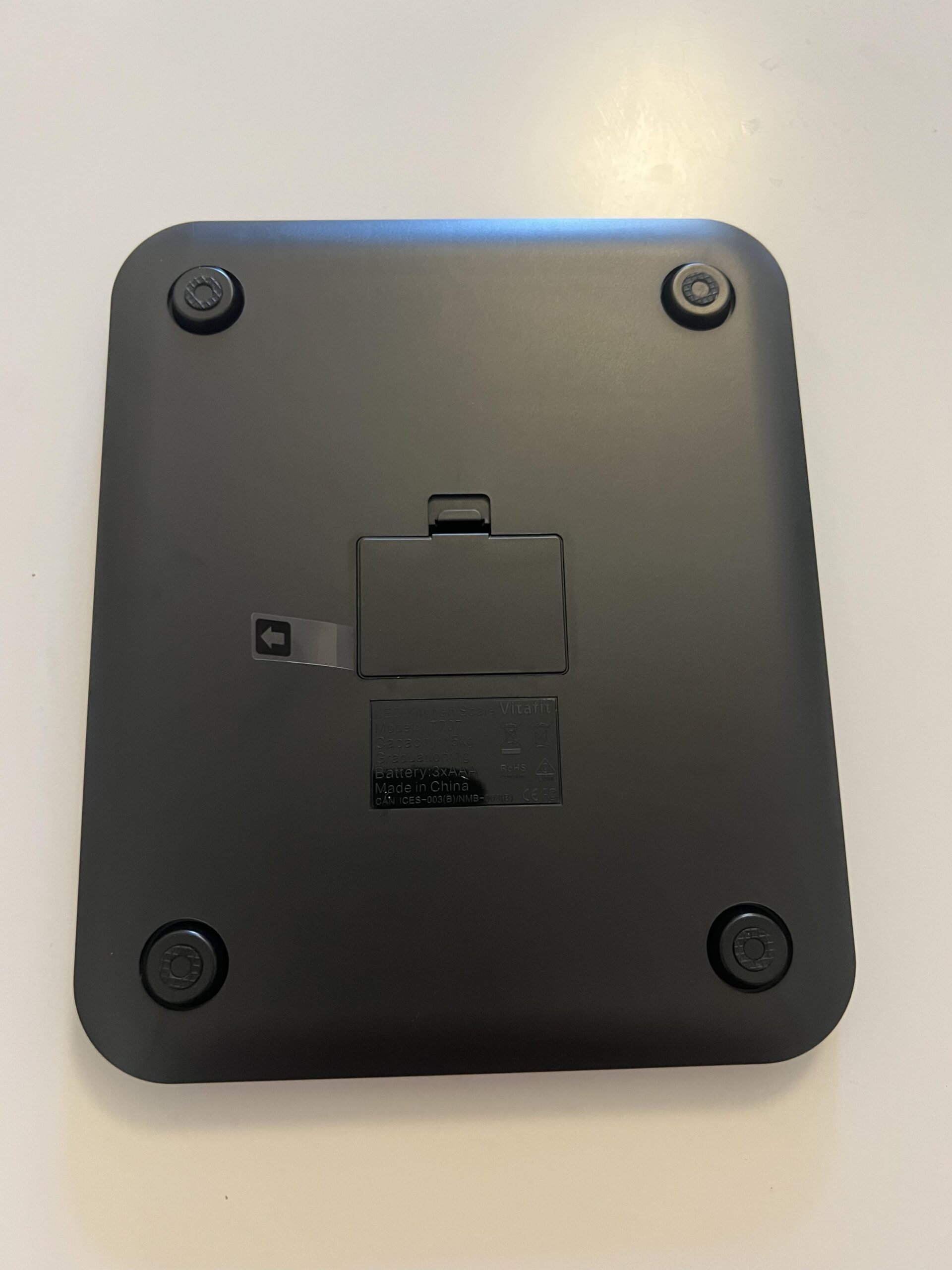
The underside photograph shows four supporting feet and a battery cover. The model documentation lists three AAA batteries. I have not run a battery-life test or assessed how its accuracy holds up after months or years.
Vitafit VT707 specifications and evidence boundaries
| Detail | Verified listing / observation | Buyer implication |
|---|---|---|
| Model | Vitafit VT707, black; Amazon reference B08SGBS7RQ | Do not confuse with other Vitafit 5 kg/10 kg or precision models |
| Maximum capacity | 15 kg / 33 lb (specified, not full-load tested) | Good for larger bowls and batches if this rating fits your needs |
| Graduation | 1 g displayed increments (not certified ±1 g performance) | Does not guarantee very tiny objects register |
| Approx. dimensions | 215 × 180 × 22 mm (listed) | Manageable counter footprint with a useful platform |
| Surface | Tempered black glass; felt sturdy in my regular use | Attractive and wipeable, but fingerprints show |
| Screen and tare | LED / tare; both convenient in my hands-on use | Especially good screen readability, including photos |
| Power | 3 × AAA, according to documentation | Common replaceable batteries; longevity not checked |
| My purchase | €10.99 on 12 October 2026 | Historical price only, not a current offer |
| My original readouts | Cashew 0 g repeatedly; marker 11 g; carton 1,079 g | Non-calibrated observations; not independent accuracy certification |
Compared with other kitchen scales I bought
This is not an invented laboratory ranking. I bought and compared other models, and my own priorities are clear: good everyday responsiveness, a readable display, 15 kg headroom and a sensible price. The practical reasons I kept the Vitafit matter more to me than how it performs with a single tiny cashew.
| Scale | Advertised capacity | My historical price | What matters to me |
|---|---|---|---|
| Vitafit VT707 (this review) | 15 kg | €10.99 | Best overall fit for me; very easy-to-read display; cashew 0 g |
| ADE KE2500-1 | 15 kg | €7.95 | Good-value 15 kg alternative, but its small-cashew test also showed 0 g |
| HomeFashion 5 kg | 5 kg | €6.79 | Its small cashew displayed 2 g in my earlier review, but it has much less capacity |
| HomeFashion GROSS 20 kg | 20 kg | €9.99 | Even more listed headroom, but its cashew also stayed at 0 g and I prefer the Vitafit |
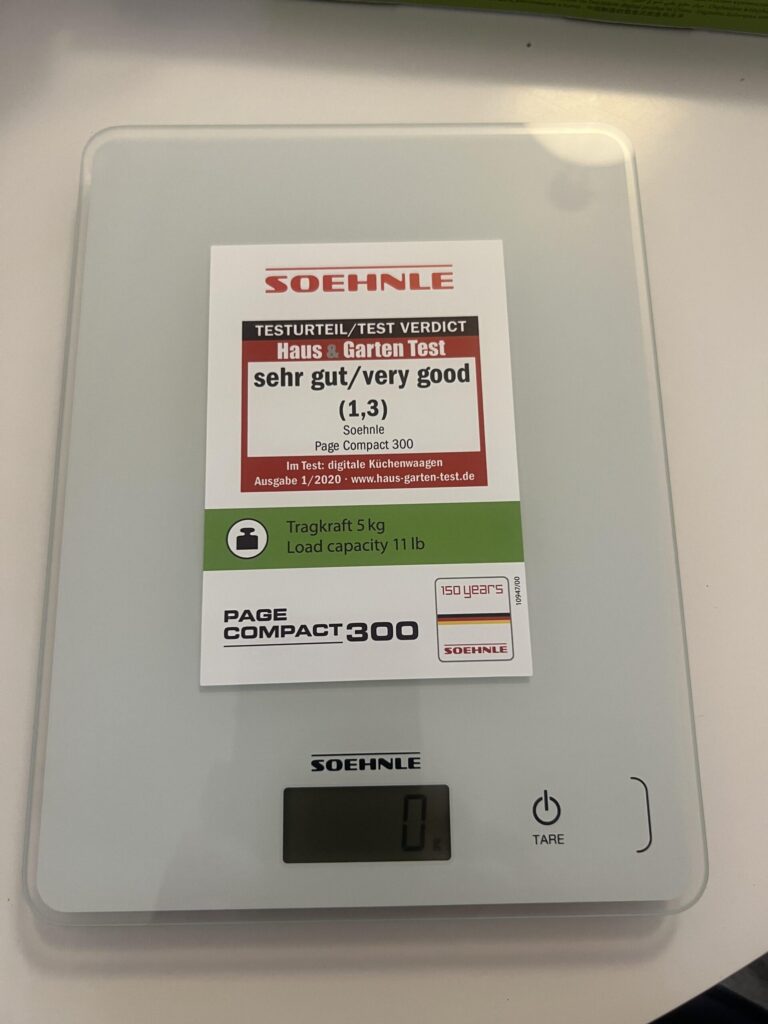
| Soehnle Page Compact 300 | 5 kg | €14.39 | My same-cashew comparison registered 2 g, though I considered the price high for 5 kg |
Historical prices represent what I paid for individual units, not today’s retail quotes. The scale tests were informal, sometimes at different times and with different objects; I did not use certified masses or a controlled cross-model procedure. For someone regularly weighing tiny quantities, the 2 g cashew readings from the 5 kg models may be more relevant than my own high-capacity preference, but they still do not prove calibrated measurement precision.
Why I rate the Vitafit 4.6/5
This is my own weighted editorial rating, not an Amazon customer average or lab score. I use six category-relevant criteria, and the weights add to 100%. I excluded long-term durability because the ownership period is too short for a fair lifetime judgment.
| Criterion | Weight | Score | First-hand basis / limitation |
|---|---|---|---|
| Everyday weighing responsiveness | 30% | 4.7/5 | Fast, stable readings for the normal kitchen tasks I actually perform |
| Display and controls | 25% | 4.9/5 | Exceptionally clear on camera and to my eyes; easy tare and simple buttons |
| Capacity and usable footprint | 15% | 4.7/5 | 15 kg stated headroom and a convenient platform, but no 15 kg load test |
| Build and cleaning | 10% | 4.3/5 | Sturdy feel and easy surface care; fingerprints are visible |
| Very-light-item handling | 5% | 2.5/5 | My repeated cashew attempt registered 0 g; small loads aren’t a priority for me |
| Value at my purchase price | 15% | 4.9/5 | €10.99 felt inexpensive for this combination of capacity and daily usability |
Reproducible calculation: (4.7 × 30%) + (4.9 × 25%) + (4.7 × 15%) + (4.3 × 10%) + (2.5 × 5%) + (4.9 × 15%) = 4.63, rounded to 4.6/5. I weighted ordinary weighing, screen and controls most heavily because those dominate how I use the product. If you frequently weigh tiny amounts, you should assign much more weight to the limitation and may reasonably reach a lower personal verdict.
Should you buy this 15 kg scale?
- Yes, it deserves a look if your priority is a dependable-feeling everyday kitchen scale with clear digits, quick controls, plenty of advertised capacity and an inexpensive purchase price.
- Probably not if your routine depends on 1–5 g ingredients, because my same-cashew attempts repeatedly showed zero.
- Compare alternatives if five kilograms is plenty or if you particularly prefer a stainless surface; my cheaper HomeFashion 5 kg review is relevant.
- Verify with reference weights if exact measurement tolerances matter for your recipe, batch or professional process. My review does not establish accuracy across the whole range.
Frequently asked questions
Does the Vitafit VT707 really weigh 15 kg?
The exact VT707 variant is specified for a 15 kg maximum load. I have not tested that ceiling under a calibrated load, so I describe it as an advertised rating, not a measurement I personally verified.
Why did the cashew display 0 g on a 1 g scale?
A 1 g display graduation is not the same as detecting every 1 g object from zero. My cashew repeatedly displayed 0 g; I did not map the device’s activation threshold, so I cannot identify the precise cause or a definitive minimum mass for my unit.
Is the display easy to read while cooking?
For my ordinary use, yes. It is one of the best features of this scale for me, and the digits also photograph clearly. Very large containers could affect sight lines, which I have not systematically tested.
Would I buy the Vitafit again?
Yes, based on my current use and what I paid. It was my favourite among the scales I bought, and I chose to keep it. If my needs changed toward weighing tiny amounts, I would choose a precision model as a second tool.
Sources, photo evidence and limitations
This page uses my six genuine photographs and documented hands-on impressions, plus product identification/specifications from the Vitafit VT707 listing on Idealo, the Heise specification overview, and a VT706/707 manual transcription. Model variants may differ. I did not use a calibrated reference mass, test maximum load, or measure battery endurance. Any future longer-term failures would warrant updating this review and rating.
Compare my other scales: My Best Kitchen Scales 2026 comparison covers 10 personally bought weighing tools, original photographs, small-item results, capacities, and the scale I ultimately chose to keep.